1 + 1
#> [1] 2
2 + 2
#> [1] 4
plot(1:3)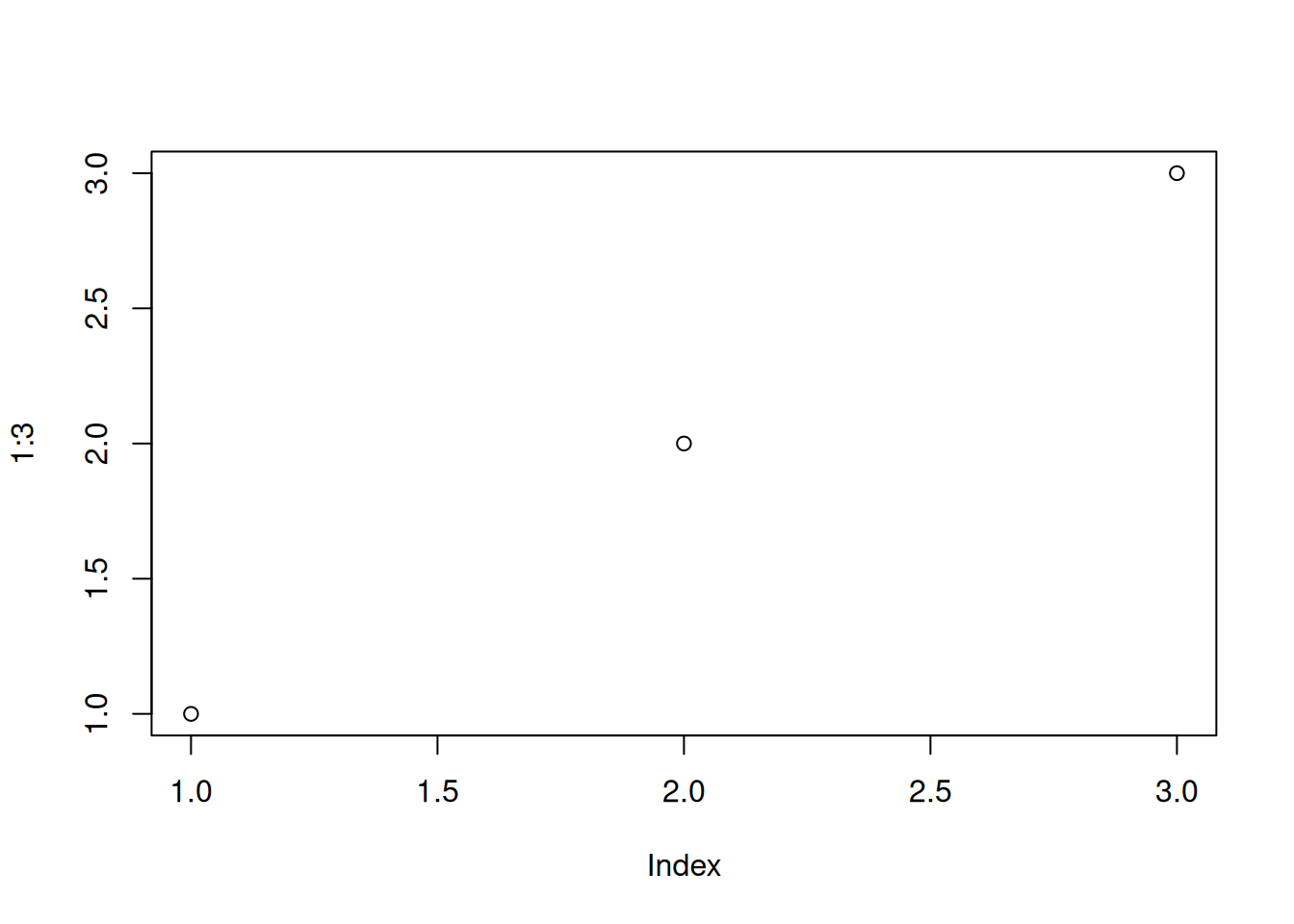
pkgdown uses Quarto only to generate HTML and then supplies its own CSS and JavaScript. This means that when Quarto introduces new features, pkgdown may lag in supporting them. If you try something that does not work and is not mentioned explicitly below, please file an issue so the pkgdown maintainers can look into it.
pkgdown turns your articles directory into a Quarto project by temporarily adding a _quarto.yml file to that directory. You can also add your own file to control options for all Quarto articles. If you do so and have a mix of .qmd and .Rmd files, you need to include the following YAML so that R Markdown can continue to handle the .Rmd files:
project:
render: ['*.qmd']The setup-r-dependencies action will automatically install Quarto in GitHub Actions if a .qmd file is present in your repository (see the install-quarto parameter for more details).
Callouts are not currently supported (https://github.com/quarto-dev/quarto-cli/issues/9963).
pkgdown assumes that you are using Quarto vignette style, or more generally an HTML format with minimal: true. Specifically, only HTML vignettes are currently supported.
You cannot customize Mermaid styles with Quarto Mermaid themes. If you want to change the colors, provide your own custom CSS as shown in the Quarto docs.
pkgdown passes the lang setting on to Quarto, but the available languages do not match perfectly. Learn more in https://quarto.org/docs/authoring/language.html, including how to supply your own translations.
The following sections demonstrate useful Quarto features to verify that they work.
Small caps
Here is a footnote reference1
1 + 1
#> [1] 2
2 + 2
#> [1] 4

plot(1:3)


\frac{\partial \mathrm C}{ \partial \mathrm t } + \frac{1}{2}\sigma^{2} \mathrm S^{2} \frac{\partial^{2} \mathrm C}{\partial \mathrm C^2} + \mathrm r \mathrm S \frac{\partial \mathrm C}{\partial \mathrm S}\ = \mathrm r \mathrm C \tag{1}
See Figure 1 for two cute puppies.
Black-Scholes (Equation 1) is a mathematical model that seeks to explain the behavior of financial derivatives, most commonly options.