
Geotag an image and return a SpatRaster using coordinates from a supported
spatial input class.
rasterpic_img() is an S3 generic. See S3 methods for supported input
classes.
Usage
rasterpic_img(
  x,
  img,
  halign = 0.5,
  valign = 0.5,
  expand = 0,
  crop = FALSE,
  ...
)

# Default S3 method
rasterpic_img(
  x,
  img,
  halign = 0.5,
  valign = 0.5,
  expand = 0,
  crop = FALSE,
  ...
)

# S3 method for class 'sf'
rasterpic_img(
  x,
  img,
  halign = 0.5,
  valign = 0.5,
  expand = 0,
  crop = FALSE,
  ...,
  mask = FALSE,
  inverse = FALSE
)

# S3 method for class 'sfc'
rasterpic_img(
  x,
  img,
  halign = 0.5,
  valign = 0.5,
  expand = 0,
  crop = FALSE,
  ...,
  mask = FALSE,
  inverse = FALSE
)

# S3 method for class 'sfg'
rasterpic_img(
  x,
  img,
  halign = 0.5,
  valign = 0.5,
  expand = 0,
  crop = FALSE,
  ...,
  mask = FALSE,
  inverse = FALSE,
  crs = NULL
)

# S3 method for class 'stars'
rasterpic_img(
  x,
  img,
  halign = 0.5,
  valign = 0.5,
  expand = 0,
  crop = FALSE,
  ...
)

# S3 method for class 'bbox'
rasterpic_img(
  x,
  img,
  halign = 0.5,
  valign = 0.5,
  expand = 0,
  crop = FALSE,
  ...,
  crs = NULL
)

# S3 method for class 'numeric'
rasterpic_img(
  x,
  img,
  halign = 0.5,
  valign = 0.5,
  expand = 0,
  crop = FALSE,
  ...,
  crs = NULL
)

# S3 method for class 'SpatRaster'
rasterpic_img(
  x,
  img,
  halign = 0.5,
  valign = 0.5,
  expand = 0,
  crop = FALSE,
  ...
)

# S3 method for class 'SpatVector'
rasterpic_img(
  x,
  img,
  halign = 0.5,
  valign = 0.5,
  expand = 0,
  crop = FALSE,
  ...,
  mask = FALSE,
  inverse = FALSE
)

# S3 method for class 'SpatExtent'
rasterpic_img(
  x,
  img,
  halign = 0.5,
  valign = 0.5,
  expand = 0,
  crop = FALSE,
  ...,
  crs = NULL
)
Arguments
- x
An R object. See S3 methods for supported classes.
- img
An image to geotag. It can be a local file or a URL, for example
"https://i.imgur.com/6yHmlwT.jpeg". Accepted file extensions arepng,jpg,jpeg,tifandtiff.- halign
A number between
0and1giving the horizontal alignment ofimgrelative tox.0alignsimgwith the left edge ofx,1aligns it with the right edge and0.5centers it horizontally.- valign
A number between
0and1giving the vertical alignment ofimgrelative tox.0alignsimgwith the bottom edge ofx,1aligns it with the top edge and0.5centers it vertically.- expand
An expansion factor of the bounding box of
x.0means that no expansion is added,1means that the bounding box is expanded to double the original size. See Details.- crop
Logical. Should the raster be cropped to the (expanded) bounding box of
x? See Details.- ...
Further arguments passed to methods.
- mask
Logical for vector methods. Should the raster be masked to the shape of
x? See Details.- inverse
Logical. Only used when
mask = TRUE. IfTRUE, areas covered byxare masked instead of areas outsidex.- crs
Character string describing a CRS. This parameter only applies when
xis aSpatExtent,sfg,bboxor a numeric coordinate vector. See the CRS section.
Value
A SpatRaster object (see terra::rast()) where each layer corresponds to
a color channel of img:
If
imghas at least 3 layers, the result names layers 1 to 3"r","g"and"b"for the red, green and blue channels and names layer 4"alpha"when applicable.If
imgalready has an RGB specification (this may be the case fortif/tifffiles), the result keeps that specification.
The resulting SpatRaster will have an RGB specification as explained in
terra::RGB().
Details
vignette("rasterpic", package = "rasterpic") explains the effect of
parameters halign, valign, expand, crop and mask with examples.
S3 methods
All methods share the parameters, return value and examples documented on this page. rasterpic groups them by input behavior:
Vector methods for the sf classes
sf,sfcandsfgand the terra classSpatVectorcan mask the image to the input shape.Extent-like methods for
bbox, numeric coordinate vectors, the stars classstarsand the terra classesSpatRasterandSpatExtentuse the input bounding box.The default method reports unsupported classes. Other packages can provide methods for additional spatial classes.
CRS
This function preserves the CRS of x when applicable. For optimal results,
do not use geographic coordinates (longitude/latitude).
crs can be in WKT format, as an "authority:number" code such as
"EPSG:4326" or as a PROJ-string such as "+proj=utm +zone=12". It can also
be retrieved with:
See the Value and Notes sections in terra::crs().
See also
vignette("rasterpic", package = "rasterpic") for examples.
From sf:
vignette("sf1", package = "sf")to understand how sf organizes R objects.
From stars:
From terra:
For plotting:
Other image geotagging tools:
asp_ratio()
Examples
# \donttest{
library(sf)
#> Linking to GEOS 3.12.1, GDAL 3.8.4, PROJ 9.4.0; sf_use_s2() is TRUE
library(terra)
library(ggplot2)
library(tidyterra)
#>
#> Attaching package: ‘tidyterra’
#> The following object is masked from ‘package:stats’:
#>
#> filter
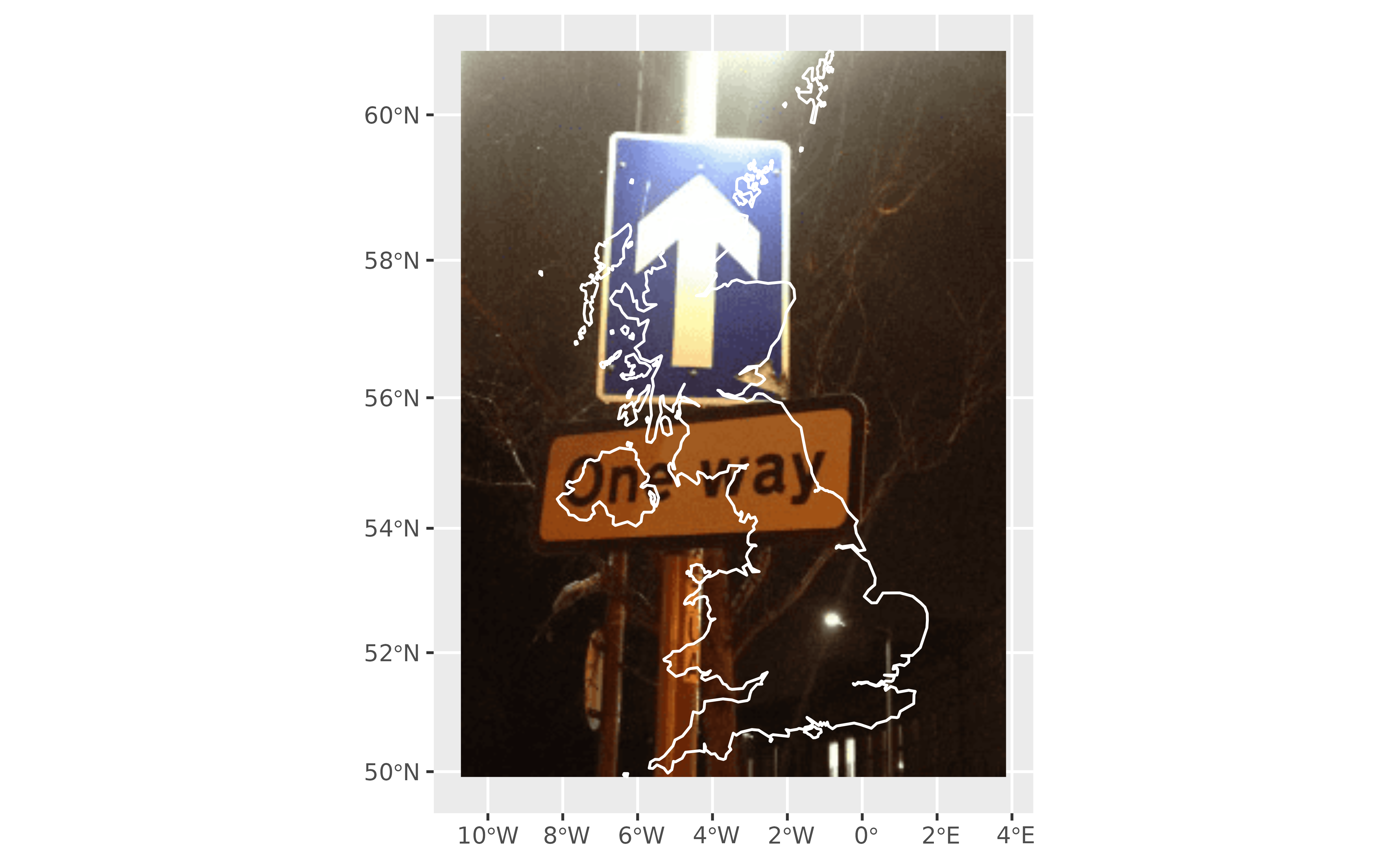
x_path <- system.file("gpkg/UK.gpkg", package = "rasterpic")
x <- st_read(x_path, quiet = TRUE)
img <- system.file("img/vertical.png", package = "rasterpic")
# Use the default configuration.
ex1 <- rasterpic_img(x, img)
ex1
#> class : SpatRaster
#> size : 333, 250, 3 (nrow, ncol, nlyr)
#> resolution : 6484.467, 6484.467 (x, y)
#> extent : -1193414, 427703.2, 6430573, 8589900 (xmin, xmax, ymin, ymax)
#> coord. ref. : WGS 84 / Pseudo-Mercator (EPSG:3857)
#> source(s) : memory
#> colors rgb : 1, 2, 3
#> names : r, g, b
#> min values : 15, 8, 4
#> max values : 254, 255, 254
autoplot(ex1) +
geom_sf(data = x, fill = NA, color = "white", linewidth = 0.5)
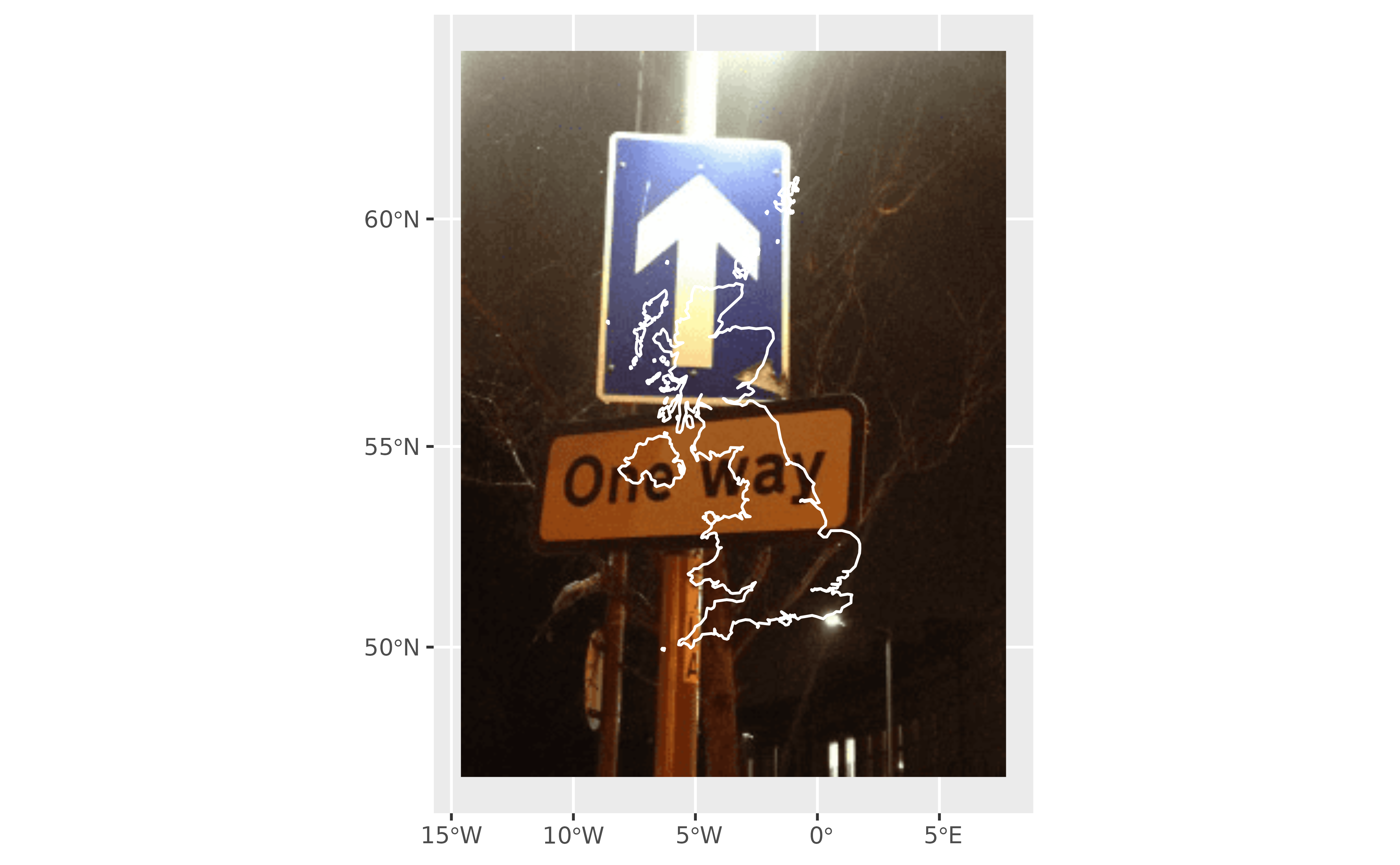
 # Expand the bounding box.
ex2 <- rasterpic_img(x, img, expand = 0.5)
autoplot(ex2) +
geom_sf(data = x, fill = NA, color = "white", linewidth = 0.5)
# Expand the bounding box.
ex2 <- rasterpic_img(x, img, expand = 0.5)
autoplot(ex2) +
geom_sf(data = x, fill = NA, color = "white", linewidth = 0.5)
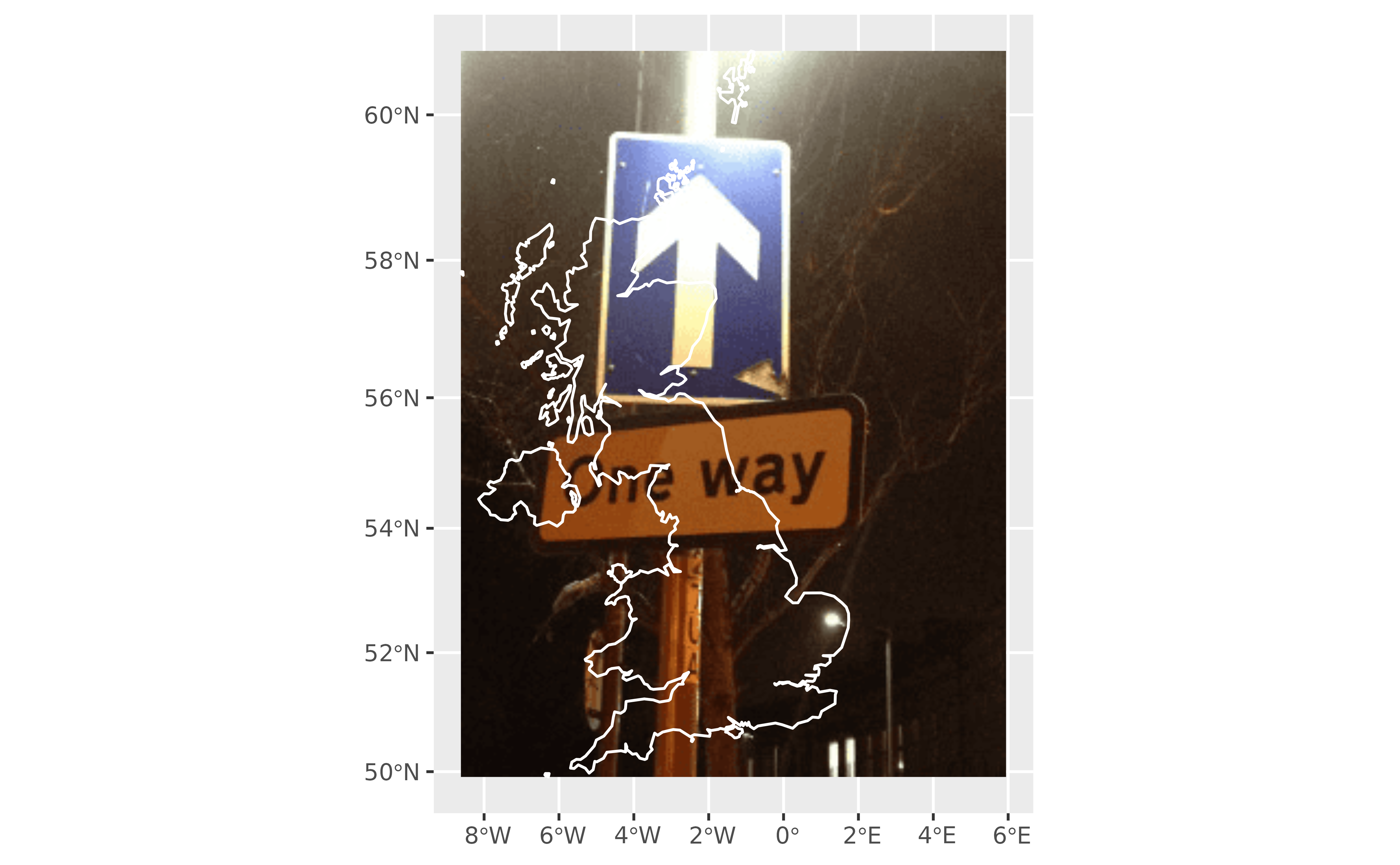
 # Align the image to the left edge.
ex3 <- rasterpic_img(x, img, halign = 0)
autoplot(ex3) +
geom_sf(data = x, fill = NA, color = "white", linewidth = 0.5) +
labs(title = "Align")
# Align the image to the left edge.
ex3 <- rasterpic_img(x, img, halign = 0)
autoplot(ex3) +
geom_sf(data = x, fill = NA, color = "white", linewidth = 0.5) +
labs(title = "Align")
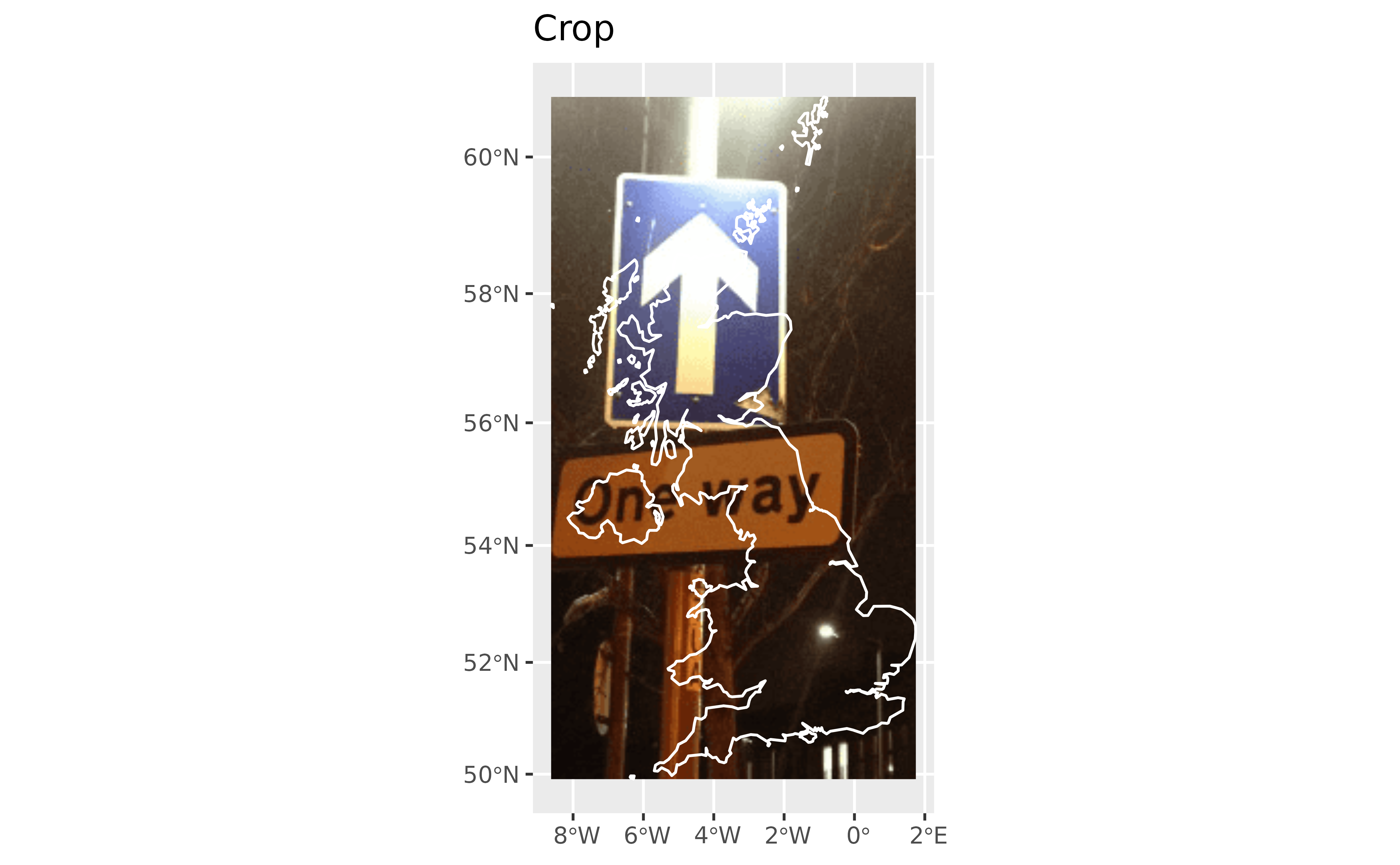
 # Crop to the bounding box.
ex4 <- rasterpic_img(x, img, crop = TRUE)
autoplot(ex4) +
geom_sf(data = x, fill = NA, color = "white", linewidth = 0.5) +
labs(title = "Crop")
# Crop to the bounding box.
ex4 <- rasterpic_img(x, img, crop = TRUE)
autoplot(ex4) +
geom_sf(data = x, fill = NA, color = "white", linewidth = 0.5) +
labs(title = "Crop")
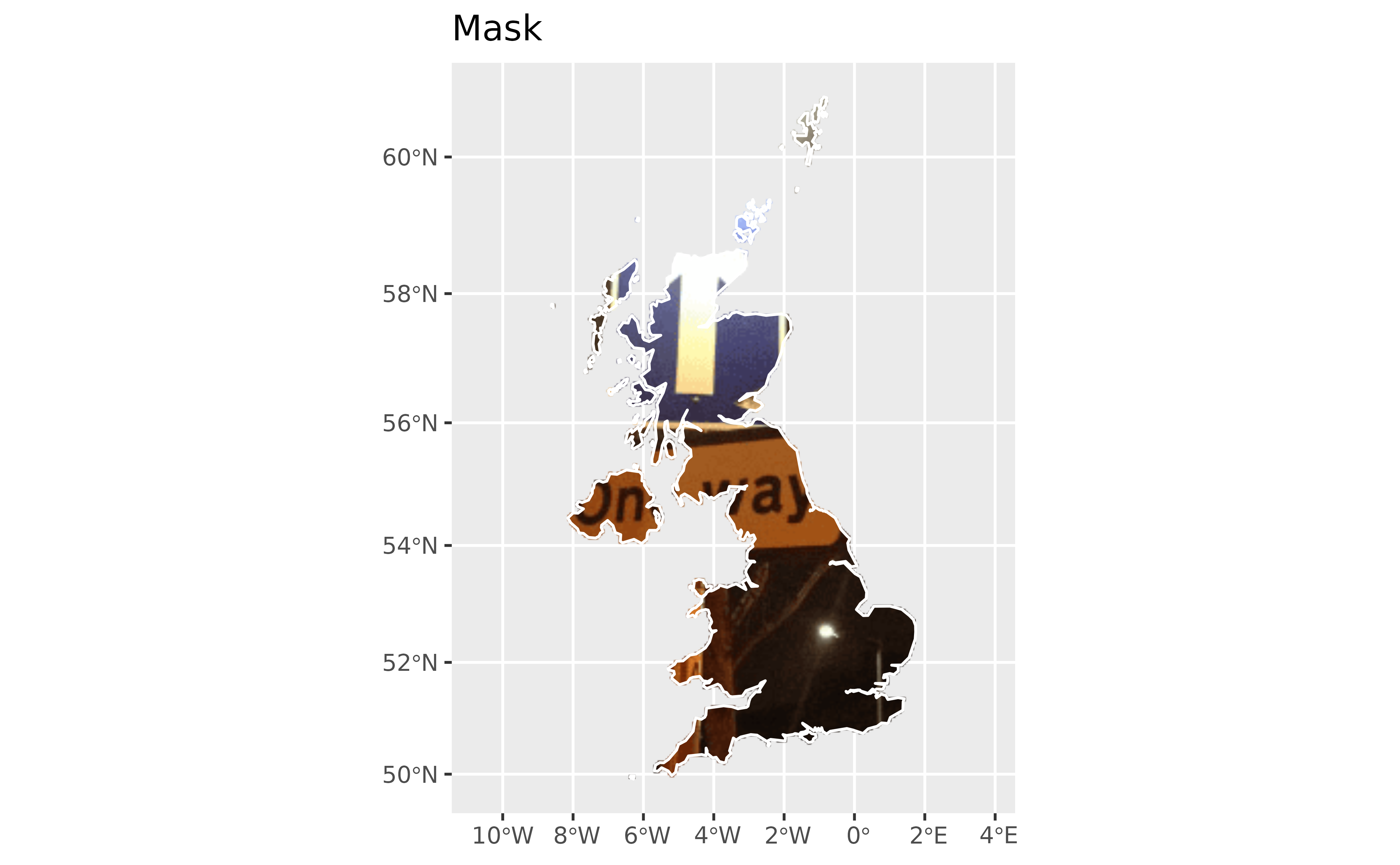
 # Mask to the vector shape.
ex5 <- rasterpic_img(x, img, mask = TRUE)
autoplot(ex5) +
geom_sf(data = x, fill = NA, color = "white", linewidth = 0.5) +
labs(title = "Mask")
# Mask to the vector shape.
ex5 <- rasterpic_img(x, img, mask = TRUE)
autoplot(ex5) +
geom_sf(data = x, fill = NA, color = "white", linewidth = 0.5) +
labs(title = "Mask")
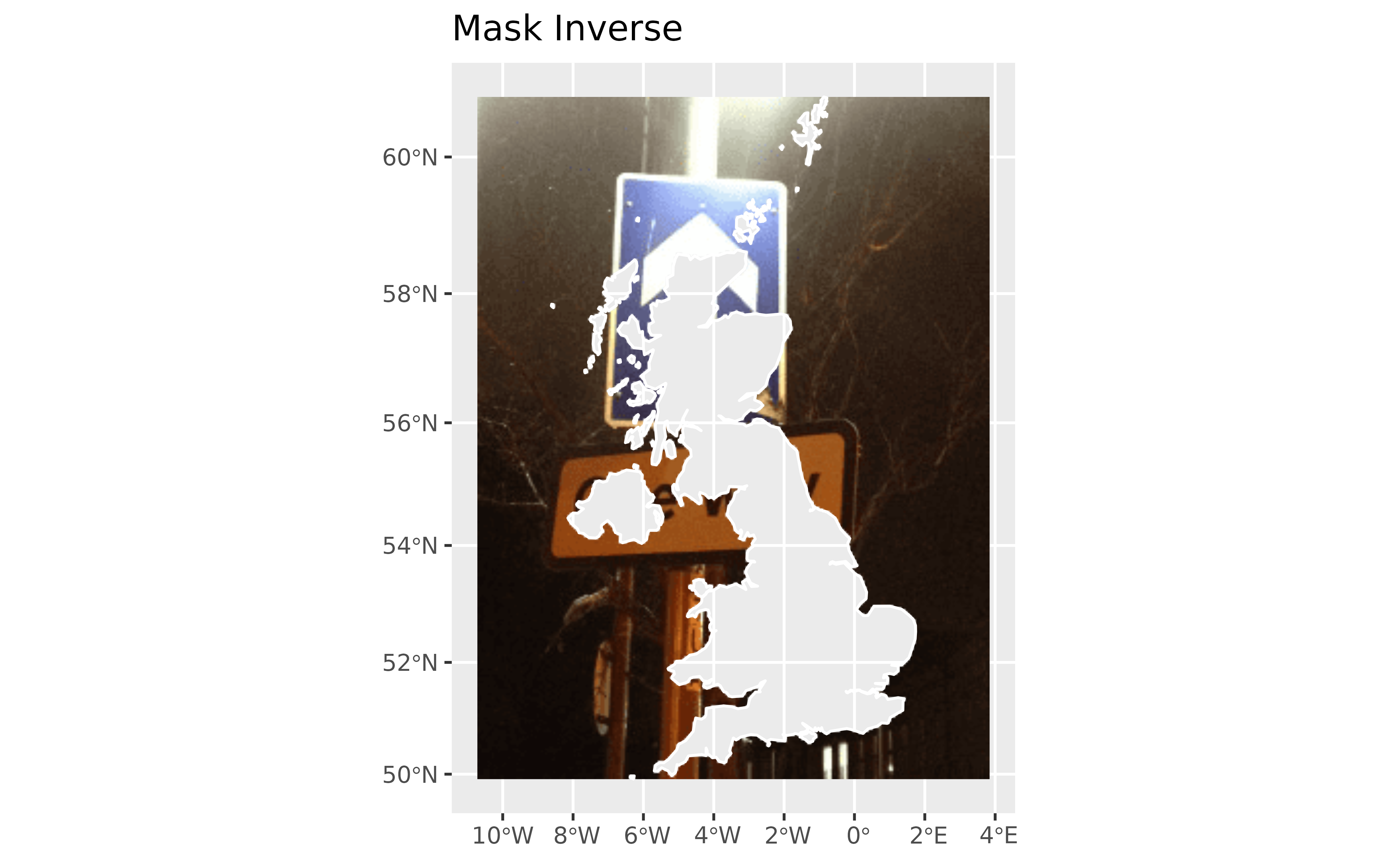
 # Mask outside the vector shape.
ex6 <- rasterpic_img(x, img, mask = TRUE, inverse = TRUE)
autoplot(ex6) +
geom_sf(data = x, fill = NA, color = "white", linewidth = 0.5) +
labs(title = "Mask Inverse")
# Mask outside the vector shape.
ex6 <- rasterpic_img(x, img, mask = TRUE, inverse = TRUE)
autoplot(ex6) +
geom_sf(data = x, fill = NA, color = "white", linewidth = 0.5) +
labs(title = "Mask Inverse")
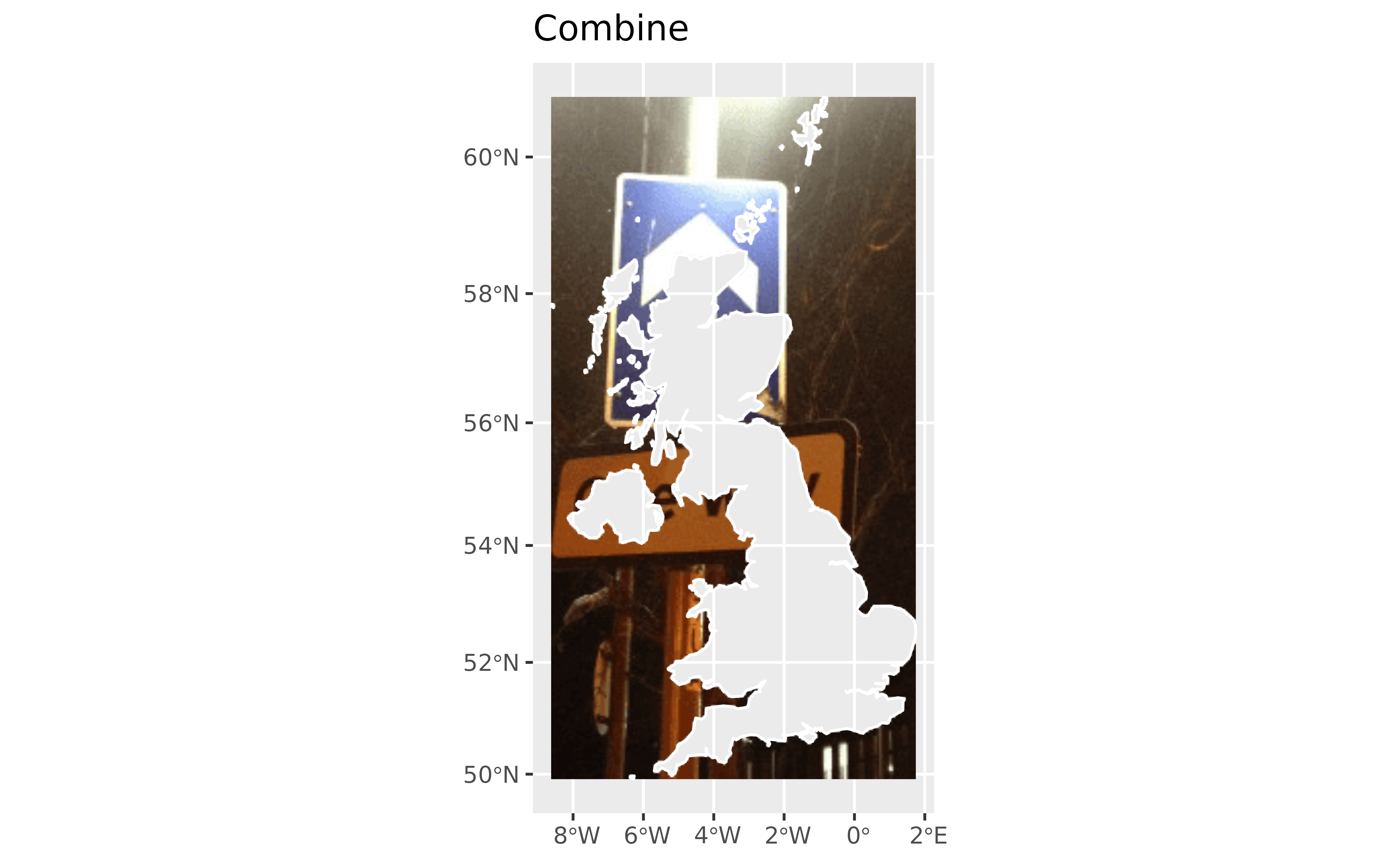
 # Combine cropping and inverse masking.
ex7 <- rasterpic_img(x, img, crop = TRUE, mask = TRUE, inverse = TRUE)
autoplot(ex7) +
geom_sf(data = x, fill = NA, color = "white", linewidth = 0.5) +
labs(title = "Combine")
# Combine cropping and inverse masking.
ex7 <- rasterpic_img(x, img, crop = TRUE, mask = TRUE, inverse = TRUE)
autoplot(ex7) +
geom_sf(data = x, fill = NA, color = "white", linewidth = 0.5) +
labs(title = "Combine")
 # }
# }