
The package code is MIT licensed. Always acknowledge geoBoundaries when sharing downloaded boundaries or derived figures. Check the boundary metadata for any additional source attribution and licensing requirements before reuse.
Introduction
The geobounds package provides an interface for downloading and working with administrative boundaries from the Global Database of Political Administrative Boundaries, maintained by geoBoundaries (Runfola et al. 2020).
The default gbOpen product provides boundaries across multiple ADM levels. With geobounds, you can download boundaries as sf objects and integrate them into spatial workflows. For release types, dates, sources and licensing, see the metadata vignette.
This vignette explains how to choose between individual country and global composite boundaries, then covers cache management and finishes with a spatial analysis example.
Understanding the boundaries
The geoBoundaries database supports commercial, non-commercial and academic uses, subject to the license reported for each boundary. Its quality assurance includes manual review and hand digitization of physical maps where necessary.
This precision comes at a cost: some files can be quite large and may take longer to download. For visualization or general mapping purposes, the simplified boundaries are less accurate but faster to render. Request them by setting simplified = TRUE.
library(geobounds)
library(ggplot2)
library(dplyr)

# Compare resolutions.
norway <- gb_get_adm0("NOR") |>
  mutate(res = "Full resolution")
print(object.size(norway), units = "Mb")
#> 26.5 Mb

norway_simp <- gb_get_adm0(country = "NOR", simplified = TRUE) |>
  mutate(res = "Simplified")
print(object.size(norway_simp), units = "Mb")
#> 1.5 Mb

norway_all <- bind_rows(norway, norway_simp)

# Plot the boundaries.
ggplot(norway_all) +
  geom_sf(fill = "#BA0C2F", color = "#00205B") +
  facet_wrap(vars(res)) +
  theme_minimal() +
  labs(
    caption = paste(
      "Sources: geoBoundaries and the original boundary provider,",
      "check gb_get_metadata() for the license"
    )
  )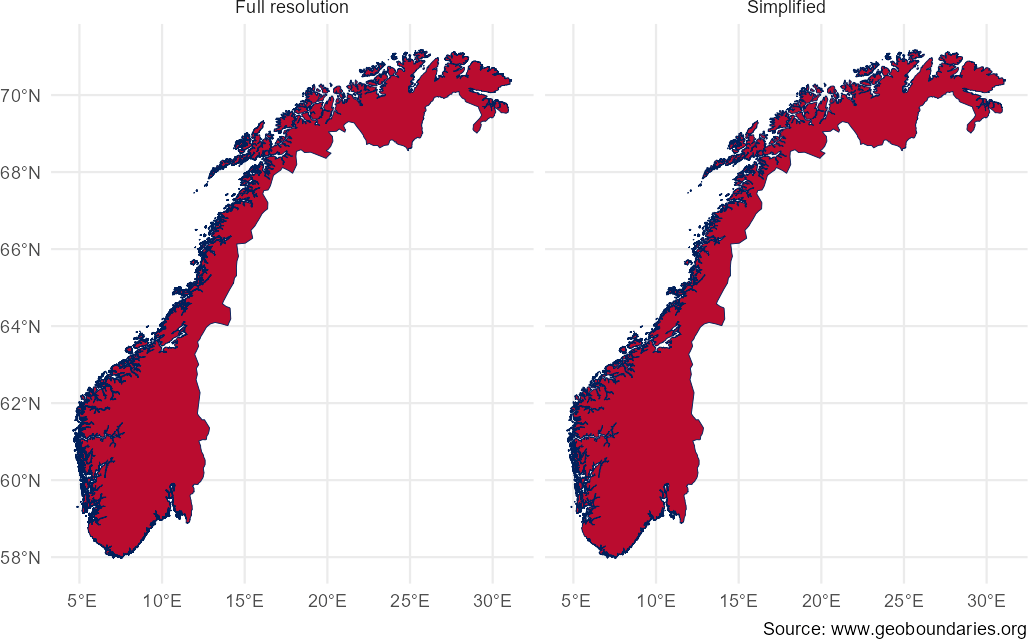
Comparison between full-resolution and simplified boundaries.
Individual country boundaries
geoBoundaries provides terrestrial administrative boundaries. Its contribution guidelines require coastal and island boundaries to exclude state-claimed waters. These data should not be interpreted as maritime boundaries or used to delineate territorial seas or exclusive economic zones.
The geoBoundaries API provides individual country boundaries that reflect how countries represent their own boundaries, without special identification of disputed areas.
Download individual country boundaries with gb_get() or the gb_get_adm*() wrappers. Borders are not guaranteed to align perfectly, gaps may exist between countries and disputed territories may not be represented consistently.
india_pak <- gb_get_adm0(c("India", "Pakistan"))

# Highlight the disputed Kashmir area.
ggplot(india_pak) +
  geom_sf(aes(fill = shapeName), alpha = 0.5) +
  scale_fill_manual(values = c("#FF671F", "#00401A")) +
  labs(
    fill = "Country",
    title = "Map of India and Pakistan",
    subtitle = "Note the overlap in the Kashmir region",
    caption = paste(
      "Sources: geoBoundaries and the original boundary providers,",
      "check gb_get_metadata() for licenses"
    )
  )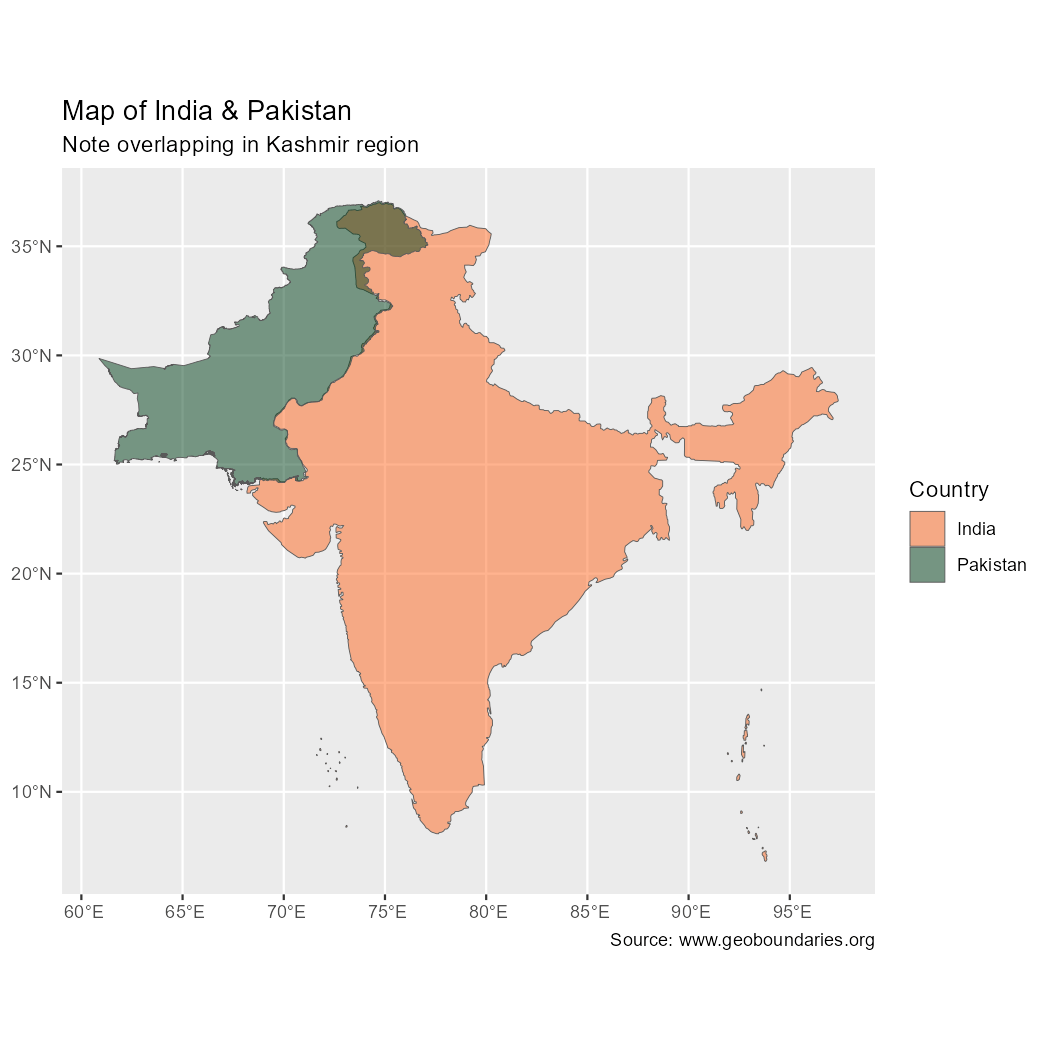
Map showing overlap in the disputed Kashmir area.
Inspect sources and licenses with gb_get_metadata() before sharing a boundary or derived product. See sources and licenses for a worked example.
Global composite boundaries
Use gb_get_world() for global composite boundaries that standardize disputed areas and fill gaps between borders. These boundaries are also known as Comprehensive Global Administrative Zones (CGAZ). They differ from individual country boundaries in three important ways:
- Extensive simplification keeps file sizes small enough for most desktop software.
- Disputed areas are removed and replaced with polygons following United States Department of State definitions.
- Gaps between borders are filled.
CGAZ boundaries and figures are not covered by the package’s MIT license. Follow the citation and use information included in each downloaded CGAZ archive.
cgaz_india_pak <- gb_get_world(c("India", "Pakistan"))

ggplot(cgaz_india_pak) +
  geom_sf(aes(fill = shapeName), alpha = 0.5) +
  scale_fill_manual(values = c("#FF671F", "#00401A")) +
  labs(
    fill = "Country",
    title = "Map of India and Pakistan",
    subtitle = "CGAZ does not overlap",
    caption = "Source: geoBoundaries (CGAZ)"
  )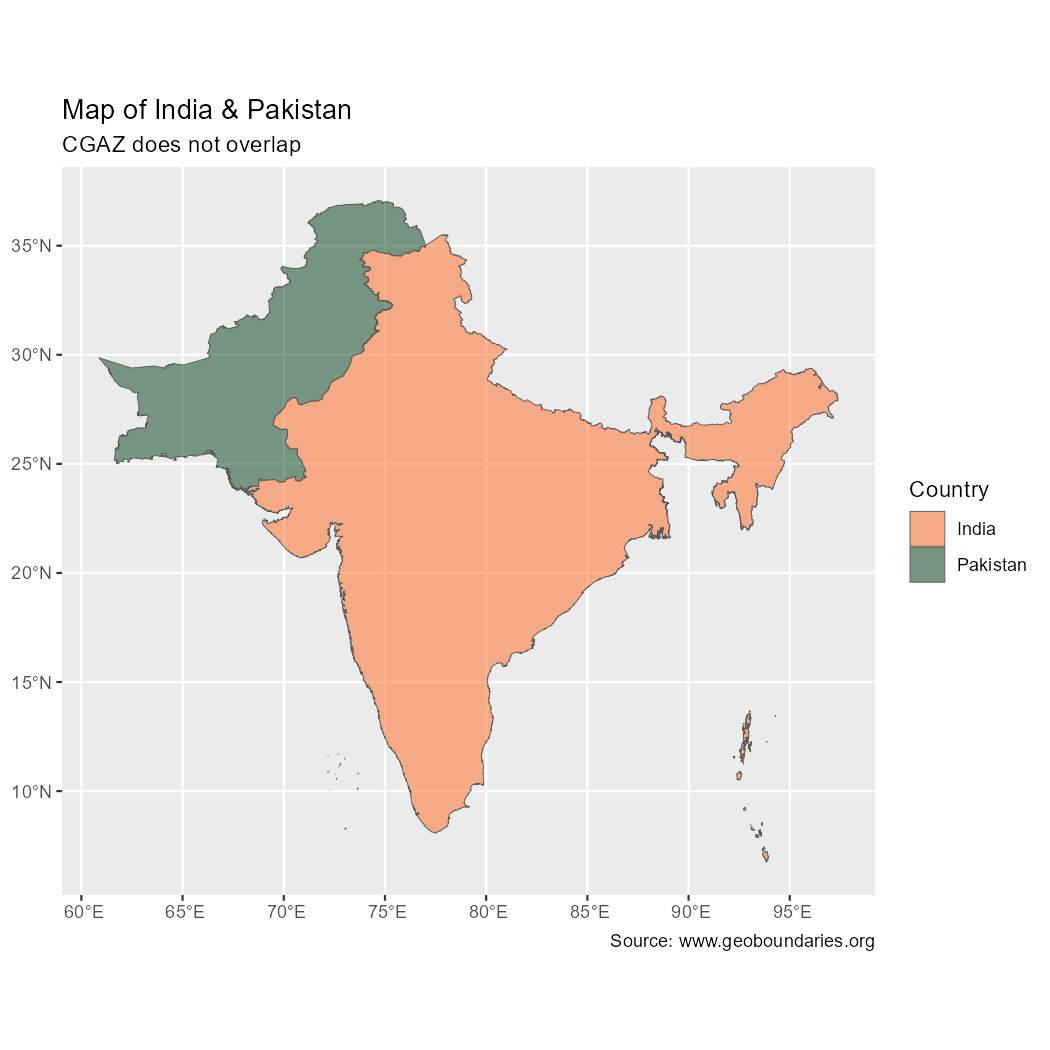
Map showing no overlap in Kashmir, provided by CGAZ.
Cache management and performance
geobounds reuses downloaded archives from a cache directory. Use cache_dir for an individual download or gb_set_cache_dir() to configure a shared directory. See ?gb_set_cache_dir for persistent cache options.
gb_get_adm1("Sri Lanka", cache_dir = "boundary-cache")gb_get_world() downloads and reads the complete global archive before selecting countries. Filtering countries reduces the returned object, but not the initial download size or memory needed to read the layer.
For cache freshness, historical versions and preserving data provenance, see the metadata vignette.
To clear the cache, use gb_clear_cache().
Spatial analysis workflows
Because boundaries are returned as sf objects, you can combine them with other spatial data:
- Clip raster data to administrative units.
- Compute zonal statistics.
- Create choropleth maps.
- Perform spatial joins with survey or tabular data.
This example creates a choropleth map using metadata from individual country boundaries and global composite boundaries from CGAZ:
# Get boundary metadata.
latam_meta <- gb_get_metadata(adm_lvl = "ADM0") |>
  select(boundaryISO, boundaryName, Continent, worldBankIncomeGroup) |>
  filter(Continent == "Latin America and the Caribbean") |>
  glimpse()
#> Rows: 47
#> Columns: 4
#> $ boundaryISO          <chr> "ABW", "AIA", "ARG", "ATG", "BES", "BHS", "BLM", …
#> $ boundaryName         <chr> "Aruba", "Anguilla", "Argentina", "Antigua and Ba…
#> $ Continent            <chr> "Latin America and the Caribbean", "Latin America…
#> $ worldBankIncomeGroup <chr> "High-income Countries", "No income group availab…

# Adjust factors.
latam_meta$income_factor <- factor(
  latam_meta$worldBankIncomeGroup,
  levels = c(
    "High-income Countries",
    "Upper-middle-income Countries",
    "Lower-middle-income Countries",
    "Low-income Countries"
  )
)

# Get global composite boundaries from CGAZ.
latam_sf <- gb_get_world(adm_lvl = "ADM0") |>
  inner_join(latam_meta, by = c("shapeGroup" = "boundaryISO"))

ggplot(latam_sf) +
  geom_sf(aes(fill = income_factor)) +
  scale_fill_brewer(palette = "Greens", direction = -1) +
  guides(fill = guide_legend(position = "bottom", nrow = 2)) +
  coord_sf(
    crs = "+proj=laea +lon_0=-75 +lat_0=-15"
  ) +
  labs(
    title = "World Bank Income Group",
    subtitle = "Latin America and the Caribbean",
    fill = "",
    caption = "Source: geoBoundaries (CGAZ and gbOpen metadata)"
  )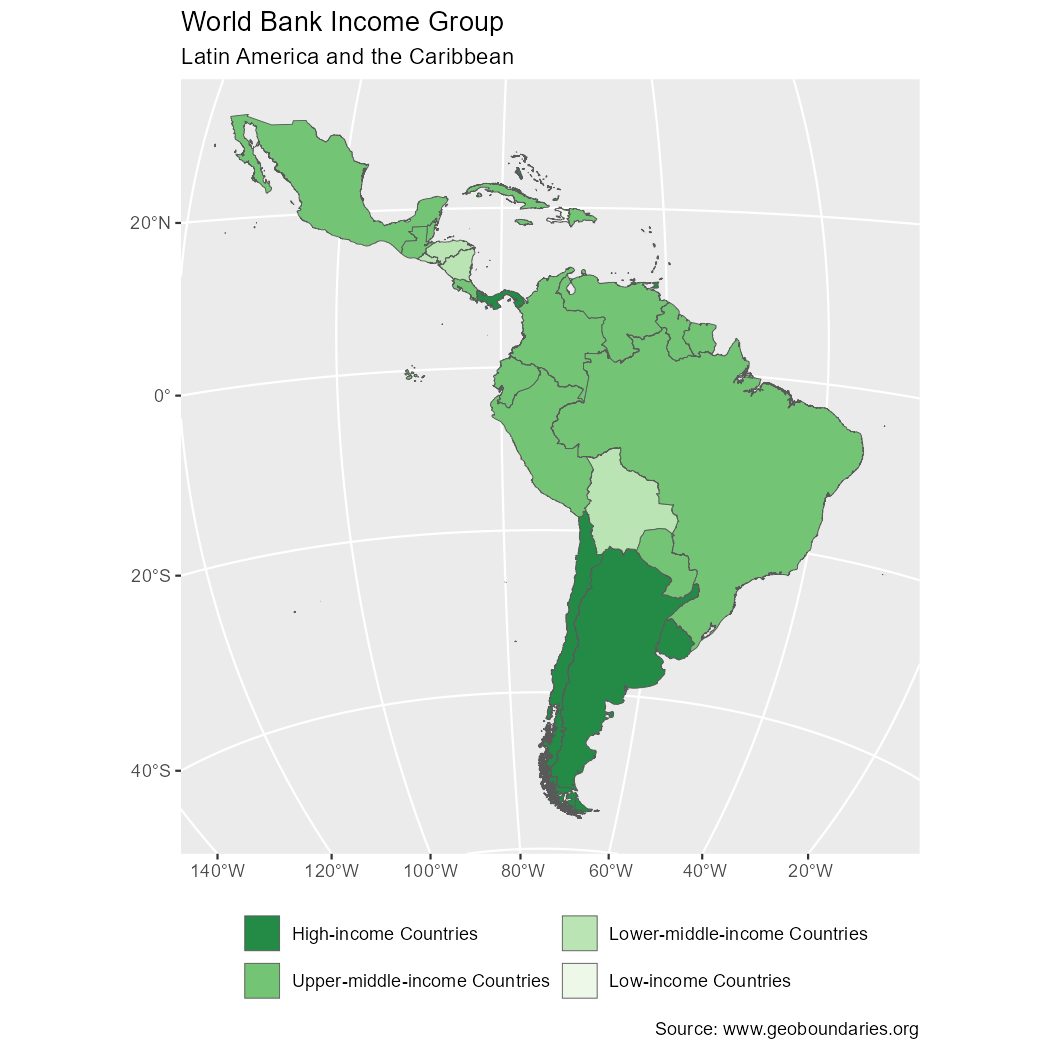
World Bank income groups: Latin America and the Caribbean.
Summary
The geobounds package supports reproducible workflows for downloading, caching and visualizing administrative boundaries. The returned sf objects can be used directly in mapping, spatial analysis and data integration workflows.