
Please cite tidyterra as:
Hernangómez, D. (2023). Using the tidyverse with terra objects: the tidyterra package. Journal of Open Source Software, 8(91), 5751, https://doi.org/10.21105/joss.05751.
A BibTeX entry for LaTeX users is:
@article{Hernangómez2023,
  doi = {10.21105/joss.05751},
  url = {https://doi.org/10.21105/joss.05751},
  year = {2023},
  publisher = {The Open Journal},
  volume = {8},
  number = {91},
  pages = {5751},
  author = {Diego Hernangómez},
  title = {Using the {tidyverse} with {terra} objects: the {tidyterra} package},
  journal = {Journal of Open Source Software}
}
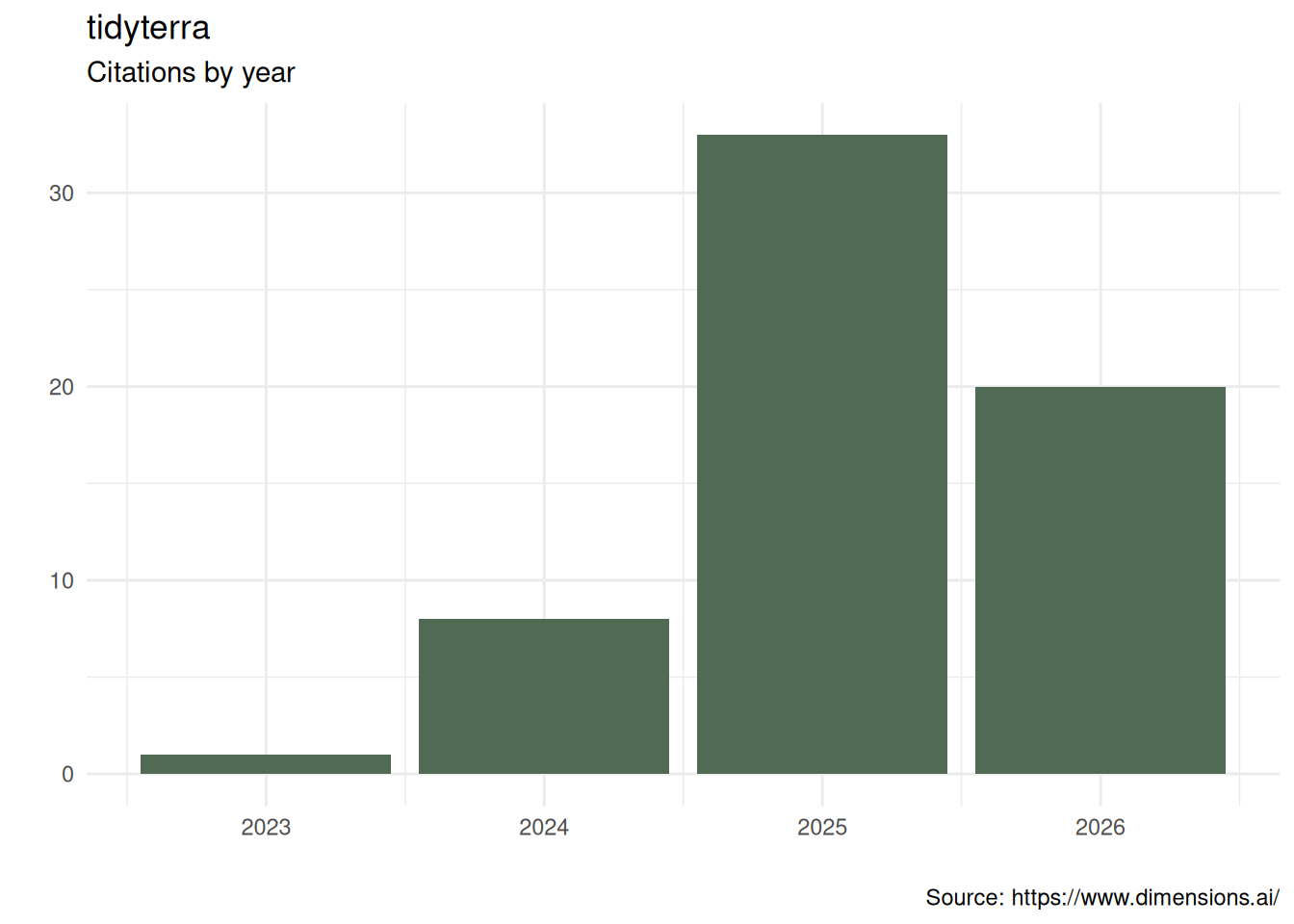
Publications
Al-Hashimi, A., Darwish, M., Al-farraj, N. S., Al-otaibi, N., Al-otaibi, A., Al-majed, M., Al-amri, S. S., & Boug, A. (2026). Escarpment refugia under threat: Climate-driven redistribution modeling of four endemic succulent species in Saudi Arabia. BMC Ecology and Evolution. https://doi.org/10.1186/s12862-026-02582-0
Aramburu, A., Beltran-Sanz, N., Raggio, J., Divakar, P. K., Pintado, A., de los Ríos, A., & Sancho, L. G. (2026). Islands of biodiversity: Characterization of lichen flora in Antarctic Nunataks. Journal of Fungi, 12(5), 314. https://doi.org/10.3390/jof12050314
Arkell, P., de Neri Machado, F., Vicco, A., Cox, V. M., Tanesi, M. Y., Ximenes, D., Hinsley, W., Bosco, F., Gomes, N., Oakley, T., Solano, V., Sheridan, S. L., David, M., Amaral, S., Freitas, L., Draper, A. D. K., Sarmento, N., Soares da Silva, E., Alves, L., … Martins, N. (2026). Sero-catalytic and spatial modeling of dengue virus force of infection in Timor-Leste. Nature Communications. https://doi.org/10.1038/s41467-026-76716-9
Bagchi, B., van Vlaenderen, L., Wheeler, T., Provencal, E., Conner, W. R., McGuire, K., Cooper, B. S., & Shropshire, J. D. (2026). Temperature-sensitive cytoplasmic incompatibility across divergent Wolbachia partly reflects cifB transcription, not endosymbiont density. Molecular Biology and Evolution, 43(8), msag186. https://doi.org/10.1093/molbev/msag186
Bahlburg, D., Menze, S., Krafft, B. A., Lowther, A. D., & Meyer, B. (2025). Mapping encounters between Antarctic krill fishing vessels and air-breathing krill predators using acoustic data from the fishery. Proceedings of the National Academy of Sciences, 122(25), e2417203122. https://doi.org/10.1073/pnas.2417203122
Baudron, F., Sibanda, T., & Falconnier, G. (2025). Supporting the codesign of agronomic innovations with data. CIRAD and CIMMYT. https://hal.science/hal-05397083v1
Bausilio, G. (2024). Urban geology and geohazards: An integrated analysis for a resilient urban planning [PhD thesis, Università degli Studi di Napoli Federico II]. https://www.fedoa.unina.it/15371/
Bausilio, G., Di Martire, D., Allocca, V., Coda, S., De Vita, P., Guerriero, L., & Calcaterra, D. (2026). Integrated analysis for a resilient urban planning using ensemble modeling and machine learning algorithms. International Journal of Disaster Risk Reduction, 138, 106124. https://doi.org/10.1016/j.ijdrr.2026.106124
Bionda, A. (2025). Biodiversity and environmental adaptation in small ruminants: Mapping temporal and spatial genomic changes in Italian sheep and goats [PhD thesis, Università degli Studi di Milano, Dipartimento di Scienze Agrarie e Ambientali - Produzione, Territorio, Agroenergia]. https://air.unimi.it/handle/2434/1199177
Bionda, A., Negro, A., Grande, S., & Crepaldi, P. (2025). Mapping risks and landscapes: Conservation insights for Italian small ruminant populations. Pastoralism: Research, Policy and Practice, 15, 14997. https://doi.org/10.3389/past.2025.14997
Buma, B. (2024). Including non-growing season emissions of N2O in US maize could raise net CO2e emissions by 31% annually. Agricultural & Environmental Letters, 9(2), e20146. https://doi.org/10.1002/ael2.20146
Chu, J., Yang, Y., Zhou, J., Jones, D. L., Ge, J., Olesen, J. E., Zeng, Z., & Zang, H. (2026). Contextual microplastic impacts on croplands from field trials and global synthesis. Global Change Biology, 32(10), e71139. https://doi.org/10.1111/gcb.71139
Coffey, M. L., & Simons, A. M. (2025). The spatial distribution of a hummingbird-pollinated plant is not strongly influenced by hummingbird abundance. American Journal of Botany, 112(5), e70034. https://doi.org/10.1002/ajb2.70034
Copot, O., & Lõhmus, A. (2026). Assessment of multiple outcomes of habitat models can significantly affect conservation decisions for threatened species. Scientific Reports, 16(1), 5860. https://doi.org/10.1038/s41598-026-35987-4
Cordeiro, N. J., Cooper, J. C., Mkongewa, V. J., Joho, M., John, J. R. M., & Ndang’ang’a, P. K. (2026). Ecological niche models result in an extreme overestimation of area of occurrence in an Endangered East African songbird. Bird Conservation International, 36, e26. https://doi.org/10.1017/s0959270926100574
Cordero, E., & Harris, A. (2026). Satellite-based surface water change detection and mesohabitat classification at Big Blue—Kansas Rivers confluence. Ecological Informatics, 104110. https://doi.org/10.1016/j.ecoinf.2026.104110
Cordero, E., Ruiz Vélez, R., Huérfano Moreno, V., & Sherman, C. (2025). Enhancing tsunami evacuation strategies in Puerto Rico using open-source least-cost path analysis. Journal of Disaster Science and Management, 1(1), 18. https://doi.org/10.1007/s44367-025-00018-y
Cortese, M. R., Canty, S. W. J., Melo-Merino, S. M., & Nowakowski, A. J. (2026). Thermal vulnerability of reef fish and implications for subsistence fisheries throughout the Caribbean. Global Change Biology, 32(10), e71118. https://doi.org/10.1111/gcb.71118
Dahl, K., Declet-Barreto, J., Cleetus, R., Spanger, E., Vitale, B., Udvardy, S., Thompson, P., Worth, P., & Caldas, A. (2024). Looming deadlines for coastal resilience: Rising seas, disruptive tides, and risks to coastal infrastructure [Technical report]. Union of Concerned Scientists. https://doi.org/10.47923/2024.15502
Dávalos-Martínez, A., Figueroa, D. S., Brancaccio-Pérez, E. S., Santiago-Pérez, A. L., & Rosas-Espinoza, V. C. (2026). Silene qumsiyehii (Caryophyllaceae: Physolychnis): una nueva especie del centro-occidente de México. Acta Botanica Mexicana, (133). https://doi.org/10.21829/abm133.2026.2655
de Carvalho Alves, M. (2026). Laboratory manual for environmental geocomputation with R (1st ed.). CRC Press. https://doi.org/10.1201/9781003724438
Di Fabio, A., Aspalter, S., Chakraborty, D., van Loo, M., Rolke, L. M., Schüler, S., Thiel, R., Veit, C., & Kreyling, J. (2026). Growth performance is driven by site conditions and moderated by functional trait plasticity in Quercus robur and Prunus avium. Ecology and Evolution, 16(2), e72978. https://doi.org/10.1002/ece3.72978
Di Fabio, A., Buttò, V., Chakraborty, D., O’Neill, G. A., Schueler, S., & Kreyling, J. (2024). Climatic conditions at provenance origin influence growth stability to changes in climate in two major tree species. Frontiers in Forests and Global Change, 7, 1422165. https://doi.org/10.3389/ffgc.2024.1422165
Drozdova, P., Shatilina, Z., Telnes, E., Gurkov, A., Saranchina, A., Mutin, A., Zolotovskaya, E., & Timofeyev, M. (2025). Prezygotic and postzygotic reproductive incompatibilities complement each other in the formation of a cryptic amphipod species: The example of a Lake Baikal species complex Eulimnogammarus verrucosus. Diversity, 17(11), 781. https://doi.org/10.3390/d17110781
Edwards, T. A., Esquerré, D., Johnston, N. P., Galvin, S., Maxwell, N. L., Encinas-Viso, F., & Dorey, J. B. (2026). Genomics reveal population crash and range contraction in elusive Fijian Hylaeus bees. Ecology and Evolution, 16(10), e74366. https://doi.org/10.1002/ece3.74366
Elio Medina, J., Plathner, F. V., Pastor, E., & Fernandez-Anez, N. (2025). How to approach the definition of WUI in Northern Europe. Fire and Materials, 49(5), 787–804. https://doi.org/10.1002/fam.3264
Fard, P., Hügel, J., Keivabu, R. C., Dominici, F., Zagheni, E., Estiri, H., & Patel, C. J. (2025). Developing a spatiotemporal repository of extreme heat and cold exposure in the United States for precision public health research. Environmental Science & Technology, 59(37), 19872–19884. https://doi.org/10.1021/acs.est.5c03658
Friesová, K., Pustková, Š., Hubatka, P., Janišová, N., Nejeschlebová, K., Rohel, J., Sobotka, V., Šmerdová, E., Večeřa, M., Kadaš, D., Kopčan, B., Krejčová, M., Kučerová, A., Axmanová, I., Dřevojan, P., Janišová, M., Nikolei, R., Szokala, D., Stanišić-Vujačić, M., … Chytrý, M. (2026). Forest herb-layer species richness in the western Balkan diversity hotspot. Journal of Vegetation Science, 37(4), e70167. https://doi.org/10.1111/jvs.70167
Fu, F., Wang, S., Wu, X., Chen, S., Tan, Z., Ye, C., & Grünzweig, J. M. (2025). Integrating hydrological impacts for cost-effective dryland ecological restoration. Communications Earth & Environment, 6(1), 667. https://doi.org/10.1038/s43247-025-02649-8
Gao, Y., Añez, N., & Chaves, L. F. (2026). High spatial resolution ensemble species distribution modeling of Rhodnius prolixus, vector of Chagas disease, in western Venezuela. GeoHealth, 10(5), e2025GH001628. https://doi.org/10.1029/2025gh001628
García-Alvarado, J. J., Pestano-González, M., González-Montelongo, C., Naranjo-Cigala, A., & Arévalo, J. R. (2025). Assessing the potential risk of invasion of the neophyte Pluchea ovalis (Pers.) DC. (Asteraceae) in the Canarian Archipelago using an ensemble of species distribution modelling. Diversity, 17(3), 195. https://doi.org/10.3390/d17030195
González-Rivero, M., Dallison, T., Wicquart, J., Brigdale, A., Logan, M., Fobert, E. K., Staub, F., & Planes, S. (Eds.). (2026). Status of Coral Reefs of the World: 2025 [Technical report]. Global Coral Reef Monitoring Network (GCRMN), International Coral Reef Initiative (ICRI). https://doi.org/10.59387/lfpr6347
Grasso, G. (2024). Soils associated to herbarium plants: A resource to address the temporal evolution of plant-associated microbiomes (Publication 2024MNHN0029) [PhD thesis, Muséum national d’histoire naturelle and Università di Torino]. https://doi.org/10.70675/19347969z4326z4f23zb1e2za8d2588a835b
Hallet, M. E., Phillips, R. A., Maywar, I. J., & Thorne, L. H. (2026). Wind, waves, wing loading and the flight energetics of giant petrels. Functional Ecology, 40(7), 1979–1993. https://doi.org/10.1111/1365-2435.70352
Hattendorf, C., & Lühken, R. (2025). Vectors, host range, and spatial distribution of Dirofilaria immitis and D. repens in Europe: A systematic review. Infectious Diseases of Poverty, 14(1), 58. https://doi.org/10.1186/s40249-025-01328-2
Herrera-Lopera, J. M., Solé, M., & Cultid-Medina, C. A. (2025). Mapping the missing: Assessing amphibian sampling completeness and overlap with global protected areas. Ecology and Evolution, 15(5), e71137. https://doi.org/10.1002/ece3.71137
Hinckley, A., Pinilla-Buitrago, G. E., Maldonado, J. E., Flores, M. F. C., Esselstyn, J. A., Inayah, N., & Hawkins, M. T. R. (2025). Pliocene forest fragmentation shaped speciation in tropical Asia’s giant squirrels (Ratufa). Molecular Ecology, 34(24), e70179. https://doi.org/10.1111/mec.70179
Jones, M. D., Almeida, R. J., Boratto, R., Talley, B. L., Buchanan, S. W., Sevin, J., Karraker, N. E., & Hunter, E. A. (2026). Long lives, short futures: Freshwater turtle and tortoise imports to the United States highlight global trade and conservation challenges. Biological Conservation, 321, 111966. https://doi.org/10.1016/j.biocon.2026.111966
Jones, M. D. (2025). Saur and decline: Patterns in lizard imports to the US (2000–2022). PLOS ONE, 20(10), e0333746. https://doi.org/10.1371/journal.pone.0333746
Kassim, Y. B., Pinto, F., MacCarthy, D. S., Bindraban, P., Chirinda, N., Stomph, T., & Struik, P. C. (2025). Can drone images predict within-field variability in soil fertility? A case study in the Northern Region of Ghana. Frontiers in Soil Science, 5, 1548645. https://doi.org/10.3389/fsoil.2025.1548645
Keshaw Vallabh, A. T. (2025). Palm Reading: Predicting the current and future distributions of non-native palm species in New Zealand [Master's thesis, The University of Auckland]. https://hdl.handle.net/2292/74143
Kiel, N. G., Watts, D. A., Young, A. B., & Vellend, M. (2025). Snowmelt timing alters the phenology but not the performance of an understory spring ephemeral plant. Journal of Ecology, 113(9), 2289–2300. https://doi.org/10.1111/1365-2745.70099
Kiziridis, D. A., Karmiris, I., & Fotakis, D. (2026). Agroforestry optimisation for climate policy: Mapping silvopastoral carbon sequestration trade-offs in the Mediterranean. Sustainability, 18(1), 439. https://doi.org/10.3390/su18010439
Kutza, A. D., Hert, Z. L., & Moyle, L. C. (2025). Endemic and invasion dynamics of wild tomato species on the Galápagos Islands, across two centuries of collection records. New Phytologist, 251(2), 737–751. https://doi.org/10.1111/nph.70321
Larocca Conte, G., Zuvela, L., Cruz-Pérez, R., Barreto-Vélez, T., Becerra-Santillan, N., Campbell, S. F., Chu, H. P., Dam, T., Grullón-Penkova, I. F., Kleit, M., Ortiz-Iglesias, D. A., Rubio-Lebrón, L. C., Cavaleri, M. A., Reed, S. C., Sihi, D., Wood, T. E., & O’Connell, C. S. (2026). Lowland tropical forests remain a methane sink under warming and long-term hurricane disturbance recovery. Agricultural and Forest Meteorology, 386, 111225. https://doi.org/10.1016/j.agrformet.2026.111225
Lebron, I., Feeney, C. J., Reinsch, S., Shokri, N., Afshar, M. H., Lofts, S., Griffiths, R., Fidler, D., Jones, B., Panagos, P., Sawicka, K., Keith, A. M., Seaton, F., & Robinson, D. A. (2025). Patterns and thresholds for soil pH across Europe in relation to soil health and degradation. CATENA, 260, 109454. https://doi.org/10.1016/j.catena.2025.109454
Lee, F., Kusabs, I. A. K., Perry, G. L. W., & MacNeil, C. (2025). Identifying refugia from the synergistic threats of climate change and invasive species. Web Ecology, 25(2), 221–239. https://doi.org/10.5194/we-25-221-2025
Lühken, R., Rauhöft, L., Pluskota, B., Lange, U., Helms, M., Becker, N., Schmidt-Chanasit, J., Kuhn, C., Tannich, E., Jansen, S., & Heitmann, A. (2024). High vector competence for chikungunya virus but heavily reduced locomotor activity of Aedes albopictus from Germany at low temperatures. Parasites & Vectors, 17(1), 502. https://doi.org/10.1186/s13071-024-06594-x
Macey, J. N., Kunberger, J. M., Collins, K., Rowin, S., Mueller, J. M., Carrasco, S. M., Colón, M. R., Grigsby, N., Raginski, N. M., Gamble, M. D., Finn, D. S., Lopez, R., & Long, A. M. (2026). Miniaturized light-level geolocators provide novel insight into the migration ecology of an endangered songbird. Movement Ecology, 14(1), 13. https://doi.org/10.1186/s40462-026-00626-0
Maitner, B. S., Richards, R. L., Carlson, B. S., Drake, J. M., & Merow, C. (2026). Flexible methods for species distribution modeling with small samples. Ecography, 2026(2), e08112. https://doi.org/10.1002/ecog.08112
Mallory, M. L., MacLean, S., Baak, J. E., Boudreau, M., Priest, J. M., Morrill, A., Provencher, J. F., & O’Driscoll, N. J. (2025). Mercury in eastern coyotes from Nova Scotia, Canada: Effects of geography and trophic position. Science of the Total Environment, 974, 179186. https://doi.org/10.1016/j.scitotenv.2025.179186
Maravall-López, J., Motti, J. M. B., Pastor, N., Tavella, M. P., Fabra, M., Babot, P., Bonomo, M., Cornero, S. E., Lamenza, G. N., Leon, D. C., Miranda de Zela, P. C., Politis, G. G., Angeletti, S. C., Cattáneo, G. R., Dantas, M., Drube, H., Gonzalez Baroni, L. G., Hocsman, S., Izeta, A. D., … Nores, R. (2025). Eight millennia of continuity of a previously unknown lineage in Argentina. Nature, 649(8097), 647–656. https://doi.org/10.1038/s41586-025-09731-3
Masson, S., Chialva, M., Bongiovanni, D., Adamo, M., Stefanini, I., & Lanfranco, L. (2025). A systematic scoping review reveals that geographic and taxonomic patterns influence the scientific and societal interest in urban soil microbial diversity. Environmental Microbiome, 20(1), 17. https://doi.org/10.1186/s40793-025-00677-7
Merlin, M., Gardiner, B., & Solberg, S. (2026). Predicting the risk of individual tree fall along powerlines in Norway with a mechanistic wind risk model and machine learning. Natural Hazards and Earth System Sciences, 26(5), 2461–2485. https://doi.org/10.5194/nhess-26-2461-2026
Merlin, M., Locatelli, T., Gardiner, B., & Astrup, R. (2025). Large-scale modelling wind damage vulnerability through combination of high-resolution forest resources maps and ForestGALES. Forest Ecosystems, 14, 100361. https://doi.org/10.1016/j.fecs.2025.100361
Mohammed, I. (2024). NASAaccess: Downloading and reformatting tool for NASA Earth observation data products. National Aeronautics and Space Administration, Goddard Space Flight Center. https://github.com/nasa/NASAaccess/releases/tag/v4.0.0
Moreira, H., Janssen, S. D., Kuipers, K. J. J., Posthuma, L., Hauck, M., Huijbregts, M. A. J., & Schipper, A. M. (2026). Combined threats of land use, climate change and nitrogen deposition to global vascular plant diversity. Global Ecology and Conservation, 69, e04307. https://doi.org/10.1016/j.gecco.2026.e04307
Moulatlet, G. M., Merow, C., Maitner, B., Boyle, B., Feng, X., Frazier, A. E., Hinojo-Hinojo, C., Newman, E. A., Roehrdanz, P. R., Song, L., Villalobos, F., Marquet, P. A., Svenning, J.-C., & Enquist, B. J. (2025). General laws of biodiversity: Climatic niches predict plant range size and ecological dominance globally. Proceedings of the National Academy of Sciences, 122(46), e2517585122. https://doi.org/10.1073/pnas.2517585122
Nityagovsky, N. N., Ananev, A. A., Suprun, A. R., Ogneva, Z. V., Dneprovskaya, A. A., Tyunin, A. P., Dubrovina, A. S., Kiselev, K. V., Sanina, N. M., & Aleynova, O. A. (2024). Distribution of Plasmopara viticola causing downy mildew in Russian Far East grapevines. Horticulturae, 10(4), 326. https://doi.org/10.3390/horticulturae10040326
Pérez-Girón, J. C., López-Bao, J. V., Díaz-Varela, E., & Álvarez-Álvarez, P. (2025). Predicting climate-related compositional shifts in nut-producing species that are important for bears during hyperphagia. Frontiers in Forests and Global Change, 8, 1624612. https://doi.org/10.3389/ffgc.2025.1624612
Raymond, C. V. (2025). Patterns, pressures and processes: Exploring biodiversity in eelgrass meadows and coral reefs [PhD thesis, University of British Columbia]. https://doi.org/10.14288/1.0449640
Read, F. R., Warmington, R. J., & Beale, C. M. (2026). Assessing protected areas as climate refugia for threatened plant species in Britain. PLOS ONE, 21(1), e0332485. https://doi.org/10.1371/journal.pone.0332485
Rees, M. (2026). Unexplored transitions between savanna and forest in Africa [PhD thesis, The University of Edinburgh]. https://doi.org/10.7488/era/7231
Reis, B. S. dos. (2025). Avaliação do sequestro de carbono nos manguezais da Baixada Santista em diferentes contextos de conservação [Bachelor's thesis]. Universidade Estadual Paulista (Unesp). https://hdl.handle.net/11449/318093
Riley, A. C., Wright, M., Porter, T. M., Maitland, V. C., Baird, D. J., & Hajibabaei, M. (2025). Biomonitoring 2.0 Refined: Observing local change through metaphylogeography using a community-based eDNA metabarcoding monitoring network. BMC Biology, 23(1), 187. https://doi.org/10.1186/s12915-025-02284-x
Rock, L. A., Fetzer, W. W., Patterson, L. S., Sillen, S. J., Steg, R., Walters, A. W., & Collins, S. M. (2025). Spatiotemporal drivers of water quality and phytoplankton communities in a cyanobacteria-dominated reservoir provide management insights. Environmental Monitoring and Assessment, 197(7), 795. https://doi.org/10.1007/s10661-025-14258-1
Royce, C. (2024). Tectonic history or climate - which has had the biggest influence on the formation of the highly diverse and endemic flora of the Western Ghats [Unpublished master's thesis, University of Edinburgh and Royal Botanic Garden Edinburgh]. https://research-scotland.ac.uk/handle/20.500.12594/28823
Rustand, D., van Niekerk, J., Krainski, E., & Rue, H. (2026). Bayesian survival, longitudinal, and joint models with INLA (1st ed.). Chapman & Hall/CRC. https://doi.org/10.1201/9781003646822
Salvador Baiges, G. (2024). Clima, orografia i dinàmiques de poblament al Pirineu Central. Arqueologia, SIG i modelització espacial del patró d’ocupació del territori durant el Neolític (5700–2100 cal ANE) [PhD thesis, Universitat Autònoma de Barcelona]. https://hdl.handle.net/10803/692148
Santiago-Sarmiento, A. P., Esparza-Estrada, C. E., Yáñez-Arenas, C. A., Ángeles-González, L. E., & Jardim, L. (2026). Ecological niche conservatism and evolutionary dynamics in Octopodidae: A phylogenetic comparative approach. Journal of Biogeography, 53(4), e70222. https://doi.org/10.1111/jbi.70222
Schmid, C. M. (2025). Spatio-temporal interpolation in archaeogenetics and archaeology: Computational methods for reconstructing human mobility and cultural history [PhD thesis, Friedrich-Schiller-Universität Jena]. https://doi.org/10.22032/dbt.69313
Schmidt, J., Dashti, S., & Torres-Machi, C. (2026). Next-generation probabilistic liquefaction model building at the regional scale. Earthquake Spectra, 42(1), e70013. https://doi.org/10.1002/esp4.70013
Scrivner, C. A. (2025). Mapping Kirtland’s Warbler (Setophaga kirtlandii) stationary non-breeding habitat: Characterizing land cover within the south-central Bahamas and evaluating the impacts of sea level rise [Master's thesis, Antioch University New England]. https://aura.antioch.edu/etds/1222/
Simons, D., Harden, C., Imirzian, N., Thompson, K. E. T., Ifebueme, N. M., Eziechina, S., Ignatius, H., Marcus, D., Aderibigbe, F., Koninga, J. T., Meremikwu, M., Moses, L., Redding, D. W., & Friant, S. (2026). Local heterogeneity in Lassa fever serology in rural Nigeria: Implications for vaccine trial site selection. PLOS Neglected Tropical Diseases, 20(5), e0014379. https://doi.org/10.1371/journal.pntd.0014379
Smoot, E. E., Flitcroft, R. L., Chan, S. S., van Deynze, B., Ewen, S., & Jardine, S. L. (2026). Projected temperature and precipitation expand modeled distributions of Reynoutria spp. while modeled distribution changes for Ludwigia spp. are scenario-dependent at watershed scales in the Pacific Northwest, USA. River Research and Applications, 42(6), 1411–1424. https://doi.org/10.1002/rra.70141
Su, X., Popescu, N., Insuk, C., Lausen, C., & Xu, J. (2025). High diversity and low genetic differentiation among geographic populations of Myotis yumanensis in Western Canada. Animals, 15(4), 578. https://doi.org/10.3390/ani15040578
Sun, Y., James, B. D., Houston, K. R., Edwards, B., Izallalen, M., Mazumder, S., Shankar, R., Reddy, C. M., & Ward, C. P. (2025). Temperature controls the lifetimes and microbial communities degrading cellulose diacetate in the coastal ocean. Environmental Science & Technology, 59(36), 19468–19478. https://doi.org/10.1021/acs.est.5c05334
Sutton, J. T., McDermid, J. L., & Ratelle, S. M. (2026). A framework to map fishing activity from incomplete data. ICES Journal of Marine Science, 83(5), fsag070. https://doi.org/10.1093/icesjms/fsag070
Tanaka, E. (2025). Examining the interface design of Tidyverse. Australian & New Zealand Journal of Statistics, 68(1), e70031. https://doi.org/10.1111/anzs.70031
Toussaint, M. (2026). Du pixel au paysage : Évaluation de l’importance du voisinage environnemental pour prédire la répartition des espèces de bryophytes en Suisse [Unpublished master's thesis, Université de Liège]. https://matheo.uliege.be/handle/2268.2/25400
Triantafillou, S. P. (2024). A catchment is more than the sum of its reaches: Post-fire resilience at multiple spatial scales [Master's thesis, Colorado State University]. https://doi.org/10.25675/3.04761
Tribbia, D. Z., Lebre, P. H., Vázquez-Campos, X., Ray, A. E., Laird, T., Machado de Lima, N., Maggs-Kölling, G., Cowan, D. A., & Ferrari, B. C. (2026). Trace gas oxidation supports sub-surface microbial communities across Namib Desert fog and aridity gradients. Applied and Environmental Microbiology, 92(8), e00265–26. https://doi.org/10.1128/aem.00265-26
Varma, V., Mosedale, J. R., Alvarez, J. A. G., & Bebber, D. P. (2025). Socio-economic factors constrain climate change adaptation in a tropical export crop. Nature Food, 6(4), 343–352. https://doi.org/10.1038/s43016-025-01130-1
Wang, G., Tang, X., Zhang, Q., Li, B., & Li, M. (2025). The relationship between soil organic matter composition and soil enzymes activities in various land use types in the upper watershed of Danjiangkou reservoir in China. Land Degradation & Development, 36(8), 2557–2570. https://doi.org/10.1002/ldr.5516
Wieczorkowski, J. D., Rajaovelona, L. R., Hermans, J., Stévart, T., Razanajatovo, H., Droissart, V., Pennington, R. T., Zizka, A., & Lehmann, C. E. R. (2026). Orchids in the open: Understanding biodiversity beyond Madagascar’s forests. Diversity and Distributions, 32(3), e70172. https://doi.org/10.1111/ddi.70172
Wiethase, J. H. (2023). Advancing ecosystem understanding: Identifying the drivers of habitat degradation, species distributions and species vulnerabilities in East African grasslands [PhD thesis, University of York]. https://etheses.whiterose.ac.uk/id/eprint/34736/
Williams, J., & Pettorelli, N. (2025). Ecosystem condition emerges from an ecological equation of state applied to North American tree communities. Current Biology, 35(7), 1672–1679.e3. https://doi.org/10.1016/j.cub.2025.02.062
Williams, J., Sandom, C. J., & Pettorelli, N. (2024). Active management is required to regenerate the Caledonian forest: Alladale as a case study. Ecological Solutions and Evidence, 5(1), e12315. https://doi.org/10.1002/2688-8319.12315
Wong, C. Y. S., Wright, M. C., van Mantgem, P. J., Latimer, A. M., & Young, D. J. N. (2025). Sentinel imagery detects the presence of live trees following large wildfires in California. Environmental Research: Ecology, 4(2), 025006. https://doi.org/10.1088/2752-664x/add5fd
Zhou, Y., Ma, S., Li, W., Kurbonova, P., Boboev, M., Li, Y., Hisoriev, H., Ma, K., Yang, W., & Zhang, Y. (2026). Vascular plant diversity and distribution pattern in Tajikistan: A global hotspot of diversity. Regional Sustainability, 7(1), 100294. https://doi.org/10.1016/j.regsus.2026.100294
Zhu, Y., Choo, J., Xia, C., & Carrasco, L. R. (2026). The pantropical biodiversity footprint of oil palm. Conservation Science and Practice, 8(9), e70394. https://doi.org/10.1111/csp2.70394