
Mutating joins add columns from y to x, matching observations based on
the keys. The four mutating joins are: inner join, left join, right join and
full join.
See dplyr::inner_join() for details.
Usage
# S3 method for class 'SpatVector'
inner_join(
  x,
  y,
  by = NULL,
  copy = FALSE,
  suffix = c(".x", ".y"),
  ...,
  keep = NULL
)

# S3 method for class 'SpatVector'
left_join(
  x,
  y,
  by = NULL,
  copy = FALSE,
  suffix = c(".x", ".y"),
  ...,
  keep = NULL
)

# S3 method for class 'SpatVector'
right_join(
  x,
  y,
  by = NULL,
  copy = FALSE,
  suffix = c(".x", ".y"),
  ...,
  keep = NULL
)

# S3 method for class 'SpatVector'
full_join(
  x,
  y,
  by = NULL,
  copy = FALSE,
  suffix = c(".x", ".y"),
  ...,
  keep = NULL
)
Arguments
- x
A
SpatVectorcreated withterra::vect().- y
A data frame or other object coercible to a data frame. If a
SpatVectororsfobject is provided, this method returns an error. Seeterra::intersect()for spatial joins.- by
A join specification created with
join_by(), or a character vector of variables to join by.If
NULL, the default,*_join()will perform a natural join, using all variables in common acrossxandy. A message lists the variables so that you can check they're correct; suppress the message by supplyingbyexplicitly.To join on different variables between
xandy, use ajoin_by()specification. For example,join_by(a == b)will matchx$atoy$b.To join by multiple variables, use a
join_by()specification with multiple expressions. For example,join_by(a == b, c == d)will matchx$atoy$bandx$ctoy$d. If the column names are the same betweenxandy, you can shorten this by listing only the variable names, likejoin_by(a, c).join_by()can also be used to perform inequality, rolling, and overlap joins. See the documentation at ?join_by for details on these types of joins.For simple equality joins, you can alternatively specify a character vector of variable names to join by. For example,
by = c("a", "b")joinsx$atoy$aandx$btoy$b. If variable names differ betweenxandy, use a named character vector likeby = c("x_a" = "y_a", "x_b" = "y_b").To perform a cross-join, generating all combinations of
xandy, seecross_join().- copy
If
xandyare not from the same data source, andcopyisTRUE, thenywill be copied into the same src asx. This allows you to join tables across srcs, but it is a potentially expensive operation so you must opt into it.- suffix
If there are non-joined duplicate variables in
xandy, these suffixes will be added to the output to disambiguate them. Should be a character vector of length 2.- ...
Other parameters passed onto methods.
- keep
Should the join keys from both
xandybe preserved in the output?If
NULL, the default, joins on equality retain only the keys fromx, while joins on inequality retain the keys from both inputs.If
TRUE, all keys from both inputs are retained.If
FALSE, only keys fromxare retained. For right and full joins, the data in key columns corresponding to rows that only exist inyare merged into the key columns fromx. Can't be used when joining on inequality conditions.
Value
A SpatVector object.
terra equivalent
Methods
Implementation of the generic dplyr::inner_join() method family for
SpatVector objects.
The geometry column has sticky behavior. This means that the result always
has the geometry of x for the records that match the join conditions.
For right_join() and full_join(), empty geometries may be returned
(since y is expected to be a data frame with no
geometries). Although these join operations are not common in spatial
workflows, the function may crash because handling of EMPTY
geometries differs between terra and sf.
See also
dplyr::inner_join(), dplyr::left_join(), dplyr::right_join(),
dplyr::full_join(), terra::merge().
Other dplyr verbs that operate on pairs of SpatVector and data frame objects:
bind_cols.SpatVector,
bind_rows.SpatVector,
cross_join.SpatVector(),
filter-joins.SpatVector,
nest_join.SpatVector(),
rows.SpatVector
Examples
library(terra)
library(ggplot2)
# Vector
v <- terra::vect(system.file("extdata/cyl.gpkg", package = "tidyterra"))
# A data frame
df <- data.frame(
cpro = sprintf("%02d", 1:10),
x = runif(10),
y = runif(10),
letter = rep_len(LETTERS[1:3], length.out = 10)
)
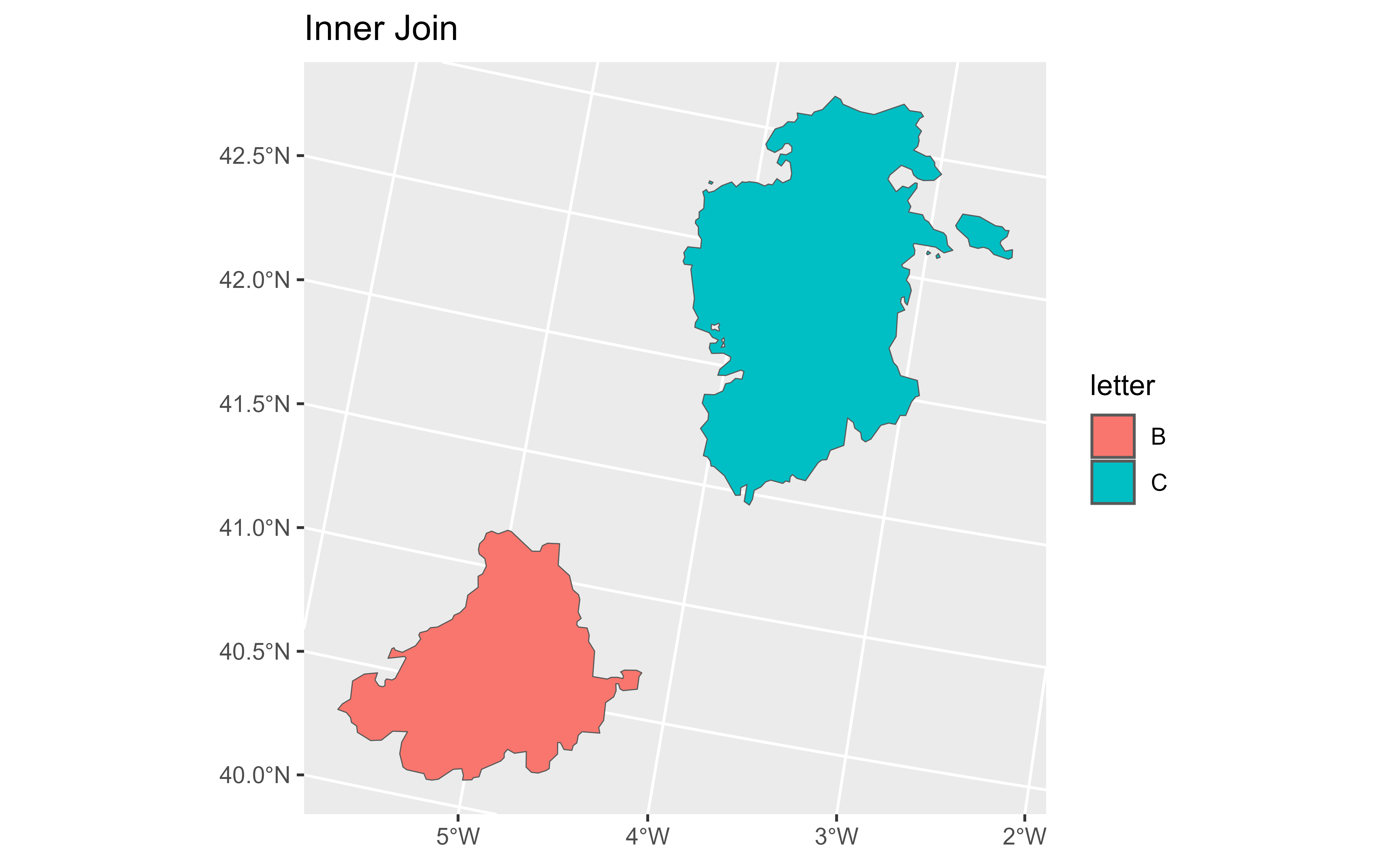
# Inner join
inner <- v |> inner_join(df)
#> Joining with `by = join_by(cpro)`
nrow(inner)
#> [1] 2
autoplot(inner, aes(fill = letter)) + labs(title = "Inner Join")
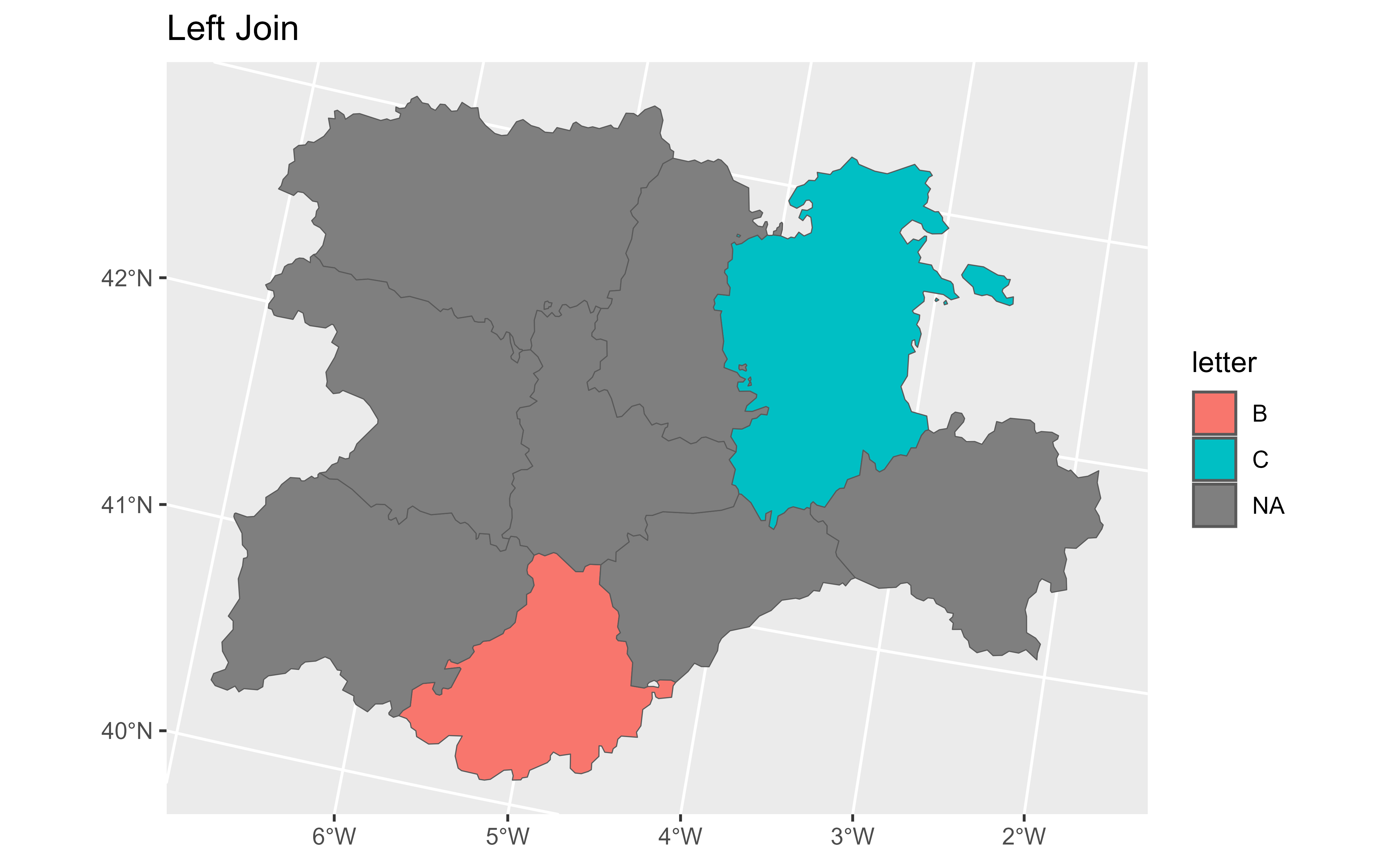
 # Left join
left <- v |> left_join(df)
#> Joining with `by = join_by(cpro)`
nrow(left)
#> [1] 9
autoplot(left, aes(fill = letter)) + labs(title = "Left Join")
# Left join
left <- v |> left_join(df)
#> Joining with `by = join_by(cpro)`
nrow(left)
#> [1] 9
autoplot(left, aes(fill = letter)) + labs(title = "Left Join")
 # \donttest{
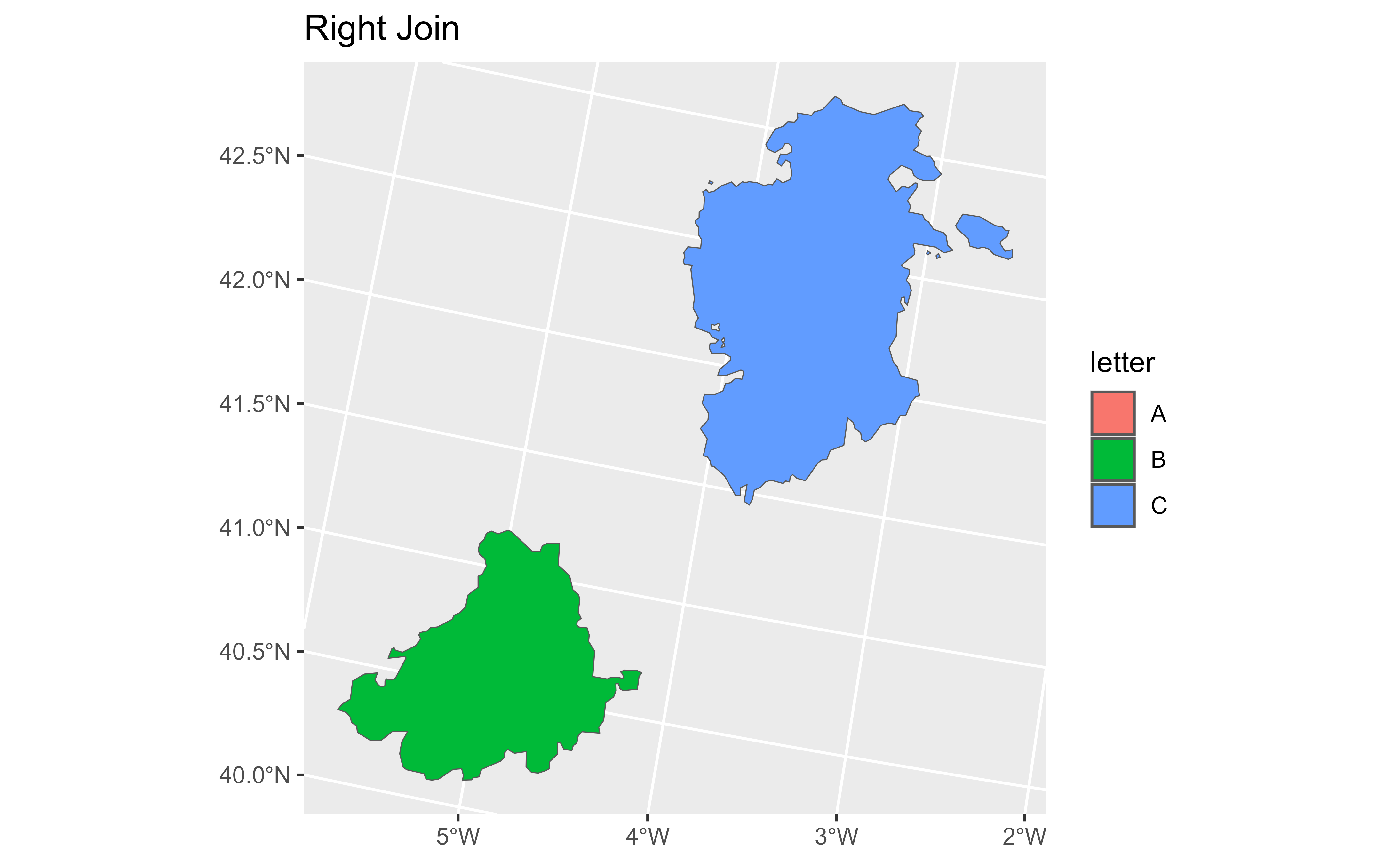
# Right join
right <- v |> right_join(df)
#> Joining with `by = join_by(cpro)`
nrow(right)
#> [1] 10
autoplot(right, aes(fill = letter)) + labs(title = "Right Join")
# \donttest{
# Right join
right <- v |> right_join(df)
#> Joining with `by = join_by(cpro)`
nrow(right)
#> [1] 10
autoplot(right, aes(fill = letter)) + labs(title = "Right Join")
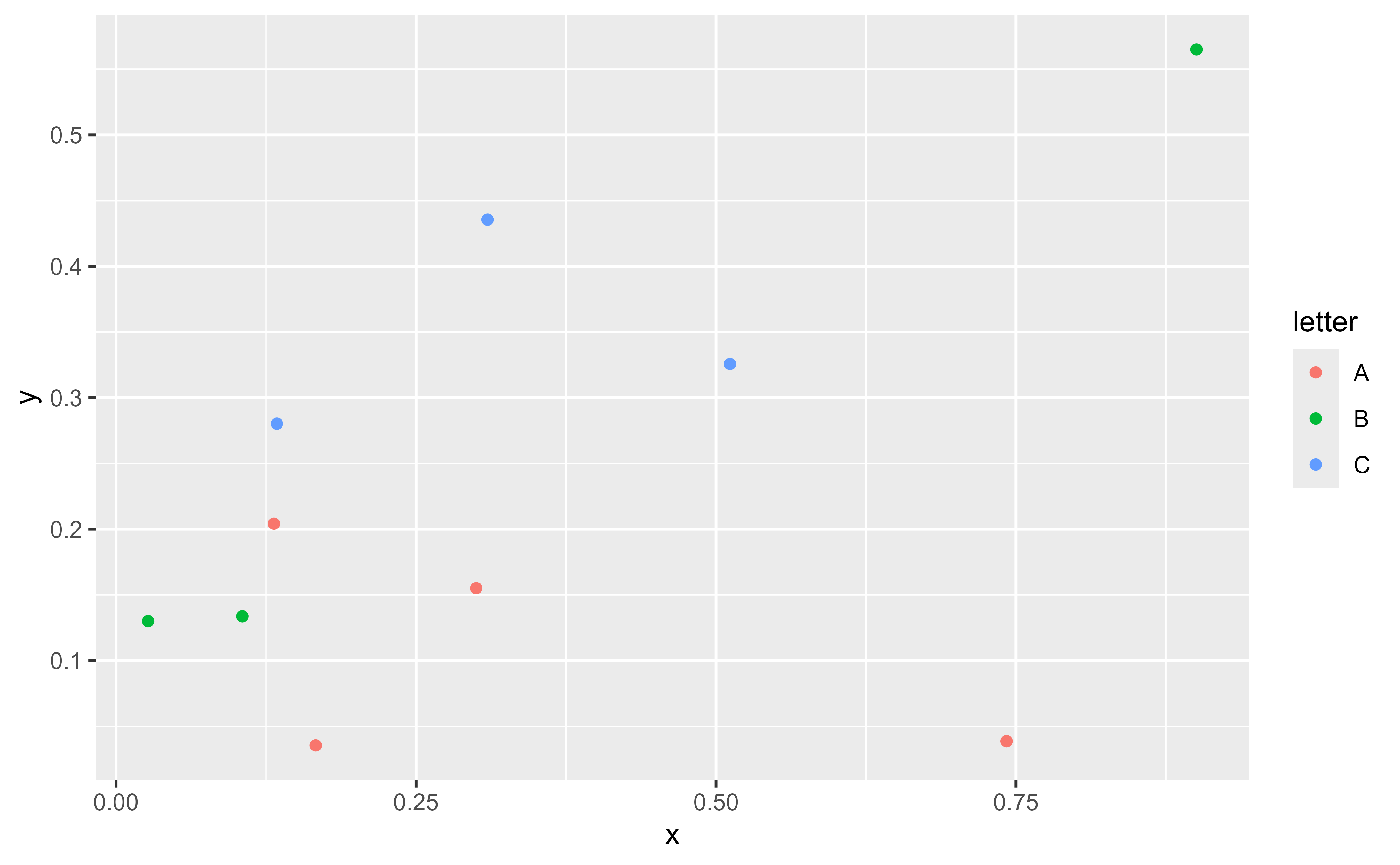
 # Check empty geometries against data from the data frame.
ggplot(right, aes(x, y)) +
geom_point(aes(color = letter))
# Check empty geometries against data from the data frame.
ggplot(right, aes(x, y)) +
geom_point(aes(color = letter))
 # Full join
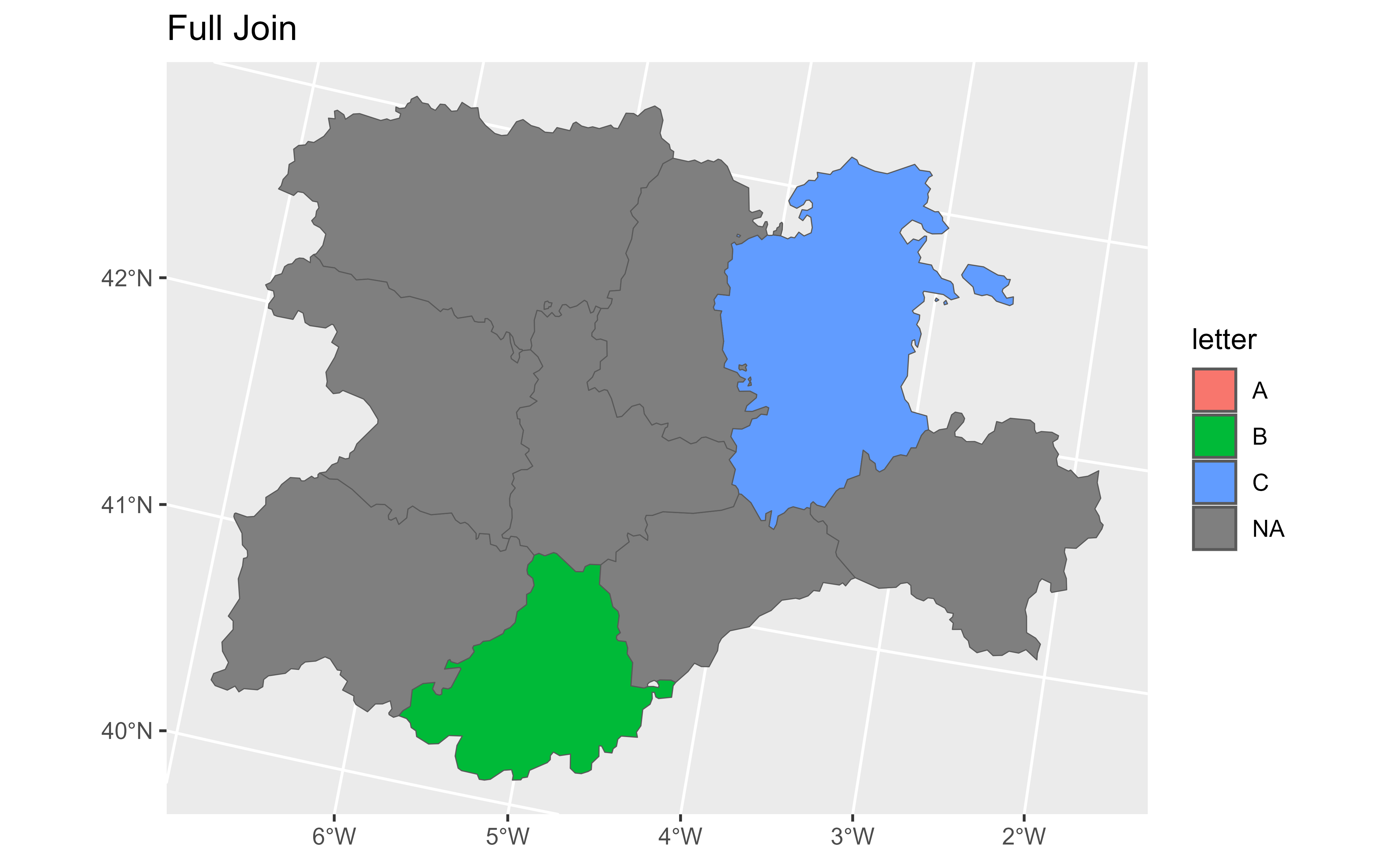
full <- v |> full_join(df)
#> Joining with `by = join_by(cpro)`
nrow(full)
#> [1] 17
autoplot(full, aes(fill = letter)) + labs(title = "Full Join")
# Full join
full <- v |> full_join(df)
#> Joining with `by = join_by(cpro)`
nrow(full)
#> [1] 17
autoplot(full, aes(fill = letter)) + labs(title = "Full Join")
 # Check against data from the data frame.
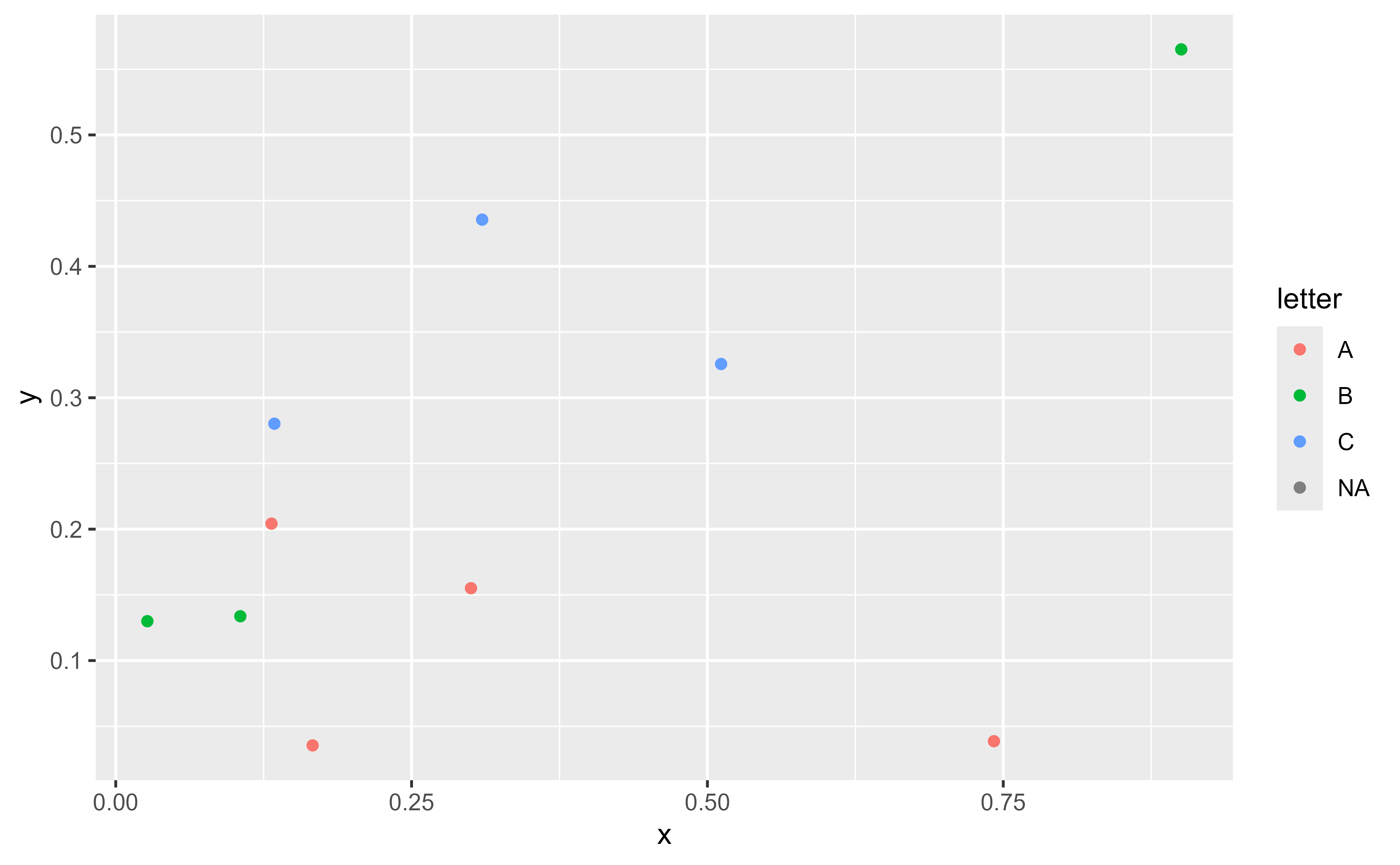
ggplot(full, aes(x, y)) +
geom_point(aes(color = letter))
#> Warning: Removed 7 rows containing missing values or values outside the scale range
#> (`geom_point()`).
# Check against data from the data frame.
ggplot(full, aes(x, y)) +
geom_point(aes(color = letter))
#> Warning: Removed 7 rows containing missing values or values outside the scale range
#> (`geom_point()`).
 # }
# }